Delve into the fascinating world of dog training, exploring the powerful principles of operant conditioning. This article illuminates the core concepts that underpin effective dog training, contrasting them with classical conditioning and providing practical insights for dog owners and trainers alike. Understanding these methodologies is key to fostering a well-behaved and happy canine companion — our dog training guide brings these principles together into a practical, beginner-friendly roadmap for every dog owner.
Understanding Operant Conditioning
Definition and Key Concepts
Operant conditioning, a term widely recognized in the realm of dog training, refers to a learning process where the strength of a behavior is modified by reinforcement or punishment. This training method focuses on voluntary behaviors and how they are influenced by their consequences. Unlike classical conditioning, which deals with involuntary responses, operant conditioning in dog training empowers dog owners to teach dogs specific actions and responses, shaping desired dog behavior through carefully applied stimuli.
Four Quadrants of Operant Conditioning
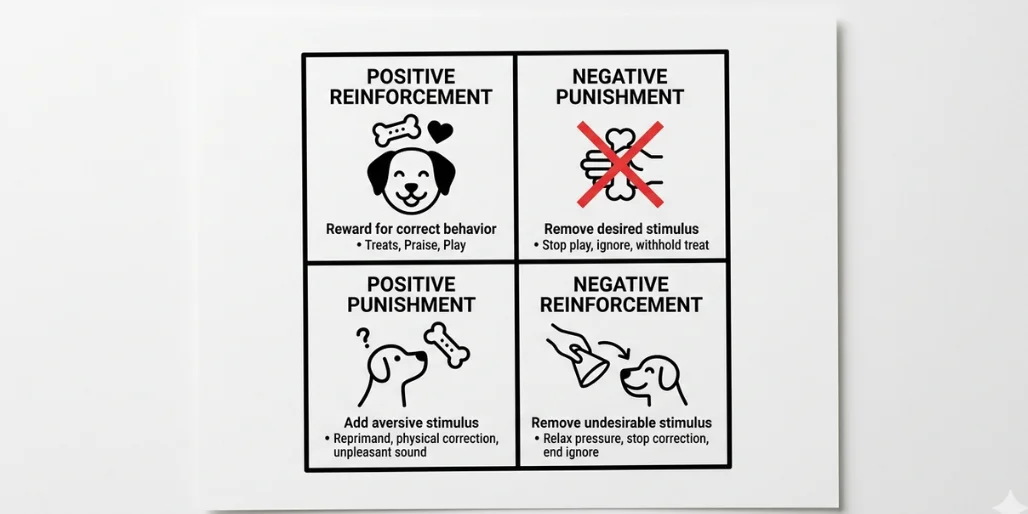
To truly grasp operant conditioning in dog training, one must understand its four quadrants, often referred to as Skinner’s quadrants after B.F. Skinner, a pioneer in the field. These quadrants each describe a distinct way to influence a dog’s behavior. The distinction between operant conditioning and classical conditioning is crucial here, as operant conditioning provides a systematic framework for trainers to analyze and modify dog learning processes effectively. These quadrants are often referred to as Skinner’s quadrants after behaviorist B.F. Skinner — the B.F. Skinner Foundation archives his original research that forms the scientific backbone of modern operant conditioning in dog training.
The four quadrants are:
| Quadrant Type | Description |
| Positive Reinforcement | Influences behavior by adding a desirable stimulus. |
| Negative Reinforcement | Influences behavior by removing an undesirable stimulus. |
| Positive Punishment | Influences behavior by adding an undesirable stimulus. |
| Negative Punishment | Influences behavior by removing a desirable stimulus. |
Positive Reinforcement Explained
Positive reinforcement is arguably the most widely used and humane method within operant conditioning in dog training. This quadrant involves giving the dog food or another desired stimulus immediately after the dog exhibits a desired behavior, thereby increasing the likelihood of that behavior recurring. For example, if a dog sits on command and the trainer gives the dog food, the dog learns that “dog sits” leads to a reward. This approach makes training enjoyable and builds a strong bond between the dog trainer and the dog, making it a cornerstone of effective dog training methods.
Classical Conditioning in Dog Training
Definition and Mechanisms
Classical conditioning, often associated with Ivan Pavlov’s experiments, is a fundamental learning process where an involuntary response is associated with a new stimulus. Unlike operant conditioning, which focuses on voluntary behaviors influenced by consequences, classical conditioning deals with automatic responses. In dog training, this often involves a dog forming an association between an environmental cue and a particular outcome, such as the sound of a treat bag opening leading to salivation, without any conscious effort on the dog’s part. This type of learning underpins many of a dog’s emotional reactions.
Comparison with Operant Conditioning
The core difference between operant conditioning and classical conditioning lies in the nature of the behavior and the role of the learner. Understanding this distinction helps dog owners apply the most effective strategies to teach dogs specific behaviors or manage emotional responses. Here’s a breakdown of their key characteristics:
| Conditioning Type | Behavior Nature & Role of Learner |
| Operant Conditioning | Voluntary actions driven by consequences (e.g., dog performs a behavior to receive a reward or avoid punishment). |
| Classical Conditioning | Involuntary, automatic responses where a dog associates a neutral stimulus with an unconditioned stimulus (e.g., a clicker signaling a treat). |
Examples of Classical Conditioning
Examples of classical conditioning in dog training are abundant. For instance, a dog might learn to associate the sound of a car door closing with the owner’s arrival, leading to excitement. Another common example is a dog’s fear of the veterinarian’s office, developed through repeated negative associations with examinations or shots. Similarly, the sight of a leash can become a conditioned stimulus for excitement about a walk. Recognizing these automatic associations allows a dog trainer to proactively create positive associations and mitigate unwanted behavior, enhancing the overall dog learning experience.
The Difference Between Operant Conditioning and Classical Conditioning
Behavioral Outcomes
The core difference between operant conditioning and classical conditioning is primarily evident in their behavioral outcomes.
| Type of Conditioning | Behavioral Outcome |
| Operant Conditioning | Focuses on voluntary behaviors; the dog actively chooses to perform an action to achieve a desired consequence (e.g., reward, avoidance of aversive stimulus). |
| Classical Conditioning | Elicits involuntary responses; the dog reacts automatically to a stimulus it has associated with a particular outcome, without conscious control. |
Training Techniques
The training techniques employed in operant conditioning and classical conditioning also diverge significantly. Operant conditioning relies on the systematic application of reinforcement and punishment to shape desired dog behavior, where a dog trainer might use positive reinforcement to reward a “dog sits” command or negative punishment by taking away a privilege for unwanted behavior. Classical conditioning, however, often involves pairing a neutral stimulus with an unconditioned stimulus to create an automatic association, such as the sound of a clicker signaling the immediate delivery of dog food.
Application in Dog Training
The application of operant conditioning and classical conditioning in dog training offers distinct benefits. Operant conditioning is highly effective for teaching dogs specific commands and actions, like “stay” or “heel,” as it directly influences a dog’s voluntary choices. Classical conditioning, on the other hand, is invaluable for managing emotional responses and creating positive associations, such as desensitizing a dog to the sound of thunder or helping a dog form a positive association with its leash, thereby preventing an unwanted behavior like a dog jumping from excitement.
Implementing Operant Conditioning in Dog Training
Using Positive Reinforcement Effectively
Effective use of positive reinforcement is paramount in operant conditioning in dog training. A dog trainer should identify what motivates their dog, whether it’s giving the dog food, praise, or a favorite toy, and deliver it immediately after the desired dog behavior. Consistency is key; every time the dog performs the correct action, such as a “dog sits” on command, reinforcement means a reward should follow. This systematic approach strengthens the association between the behavior and its positive consequence, making the dog learning process enjoyable and effective.
Choosing the Right Dog Food for Training
When implementing operant conditioning in dog training, choosing the right dog food for training is crucial for successful positive reinforcement. High-value, palatable treats that are small and easily consumed prevent distractions and maintain the dog’s focus during training sessions. The dog food should be distinct from regular meals to maintain its novelty and motivational power. This ensures that the dog perceives the reward as truly valuable, thereby enhancing the effectiveness of the training method and reinforcing desired dog behavior.
Common Mistakes to Avoid
Several common mistakes can hinder the effectiveness of operant conditioning in dog training. One major pitfall is inconsistent application of the four quadrants of operant conditioning — a related concept worth exploring is the Premack Principle, which uses high-value activities as reinforcement and builds directly on these same operant foundations. Another mistake is using positive punishment or negative reinforcement excessively, which can damage the bond between the dog owners and the dog and create fear. Furthermore, not understanding the difference between operant conditioning and classical conditioning can lead to misapplied techniques, making it difficult to teach dogs effectively.