Introduction
Nobody tells you how hard the first few weeks actually are.
Those puppy-dog eyes, that adorable face, the wagging tail at the door — you pictured walks in the park, a dog that comes when called, a happy companion that fits perfectly into your life. What you got instead is a dog that pulls until your arm aches, barks at everything, has accidents the moment you look away, and completely ignores you when you say no.
If that sounds familiar you are not failing. You are just missing the information that most new dog owners never receive.
I learned this the first time I helped a new owner bring a dog home. The excitement was real. But so was the confusion, the frustration, and the feeling that nothing they tried was working. The problem was never the dog. It was never the owner either. It was simply a gap in understanding — and that gap is exactly what this guide fills.
Dog training starts with the right owner mindset. It comes with planning, consistency, and honest answers to the questions nobody thinks to ask before the dog arrives. Being a beginner does not mean you are behind. It means you are at the perfect starting point.
This guide covers everything a complete beginner needs. The ten basic commands every dog must know. How to fix the most common problem behaviors like barking, biting, and pulling. A step by step puppy training plan. The main training methods explained in plain English. And how to know when you need a professional trainer.
It does not matter if your dog is eight weeks old or eight years old. This guide starts from zero.
Every well-trained dog you have ever admired started exactly where yours is right now.
What Dog Training Means and Why It Matters
Dog training begins at home, not just during a walk or in public. When I first started working with dogs I quickly discovered something that surprised me — good training is not about control at all. It is about teaching your dog how to behave in a human world that makes absolutely no sense to them from the moment they arrive.
A trained dog listens to simple commands, learns manners, and builds a real understanding with its owner through consistent boundaries and mutual respect.
I have seen what happens when that understanding is missing. In my own neighbourhood I watched a large black dog get beaten and shouted at every single time it misbehaved. The owner genuinely believed punishment was the answer. It never worked. The dog grew more anxious and more unpredictable with every passing week. Nobody had ever told that owner the most basic truth about dogs — that shouting at a dog which does not understand what you want is like shouting at someone in a language they have never heard. It does not teach them anything. It only makes them afraid of you. That memory is part of why I believe so strongly that every dog owner deserves access to real training information before problems start.
The benefits of proper training go much further than most new owners expect. Good potty training protects your home and reduces daily frustration. A dog that understands boundaries stops chewing your belongings and stops causing the kind of small daily chaos that quietly wears you down. But the real benefit is bigger than all of that. You spend genuine time together. You build trust. You watch your dog’s confidence grow through learning — and that bond becomes one of the most rewarding things about owning a dog.
Safety Is Not Optional
A dog that cannot be controlled is a safety risk to itself and to everyone around it. A dog that ignores recall can run into a busy road in seconds. A dog that has not been socialised can react dangerously around other animals and strangers.
But here is the place most owners never think about — the vet.
Veterinarians and their staff cannot always help a dog that reacts violently on the examination table, is not used to being touched, or has never been handled calmly by a stranger. When a dog cannot be properly examined, problems like overgrown nails, dental disease, infected wounds, and early signs of serious illness get missed entirely. Training your dog to accept handling is one of the most practical and overlooked decisions a new owner can make.
The Knowledge Stays With You Forever
Once you understand how to train a dog properly that knowledge never leaves you. You can help friends who are struggling with their own dogs. You become the person who knows why a dog is behaving the way it is — and knows how to fix it. For some people it grows into a career. For most it simply becomes a skill that makes every dog they ever own easier, happier, and safer to live with.
How Dogs Learn
Before we talk about training techniques it helps to understand something most owners never learn — how dogs actually process new information.
Dogs learn through association and consequence. Understanding how dogs communicate discomfort — through what behaviourists call the ladder of aggression — makes this principle even more powerful in practice When a behavior produces something good — a treat, praise, a toy — the dog remembers that behavior and repeats it. When a behavior produces nothing the dog gradually stops doing it. That is the entire foundation of modern dog training in two sentences. Everything else is applying that principle in different situations.
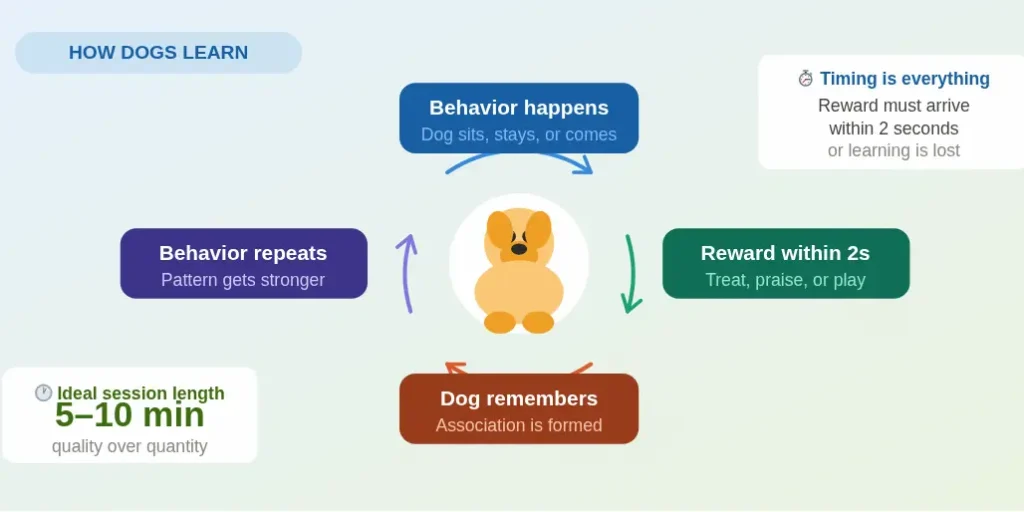
The part most people get wrong is timing. Dogs can only connect a reward to a behavior if the reward comes within two seconds of the behavior happening. Wait five seconds and the dog has already moved on mentally. It has no idea what the treat is for. This is why professional trainers use a clicker or a marker word like yes — it marks the exact moment the dog did the right thing even before the treat arrives.
Timing is just as critical during dog-to-dog encounters — our guide to the 3-Second Rule in dog training shows exactly how to apply precise timing during greetings to prevent reactivity before it starts.
How Long Should a Training Session Be
One of the most surprising things I discovered while researching dog training is how short sessions should actually be. Most new owners assume more time means more progress. Professional trainers consistently say the opposite.
Sessions of just 5 to 10 minutes hit the sweet spot for most dogs. Short focused sessions work better than long exhausting ones because dogs learn through repetition not duration. A dog that does ten correct repetitions in eight minutes learns faster than a dog that does thirty repetitions across forty minutes while gradually losing interest and focus.
Research from animal behaviorists supports what experienced trainers have known for years — mental fatigue in dogs sets in much faster than physical fatigue. A dog can run for an hour but mentally engage for only a fraction of that time. This is why the world’s top trainers keep sessions short and always end on a success.
Think of it this way. Even two minutes of focused training is progress. Zero is not. That one shift in thinking stops more people from quitting than any technique ever could.
High energy breeds like Labradors or Belgian Malinois can sometimes manage slightly longer sessions. But even with these dogs pushing past the point of genuine engagement causes regressions — behaviors the dog had mastered start breaking down because the dog is mentally overloaded. If your dog starts making mistakes it was not making ten minutes ago the session has gone on too long.
What This Means for You
Dog training should never feel like something you carve hours out of your day for. Keep sessions short, structured, and realistic — especially during the first week with a new puppy, when routine matters most. Build small wins early to maintain your own motivation as much as your dog’s. And when life gets in the way and you only have two minutes — use them. Consistent short effort repeated daily will always outperform an hour long session once a week.
The 5 Main Dog Training Methods Explained
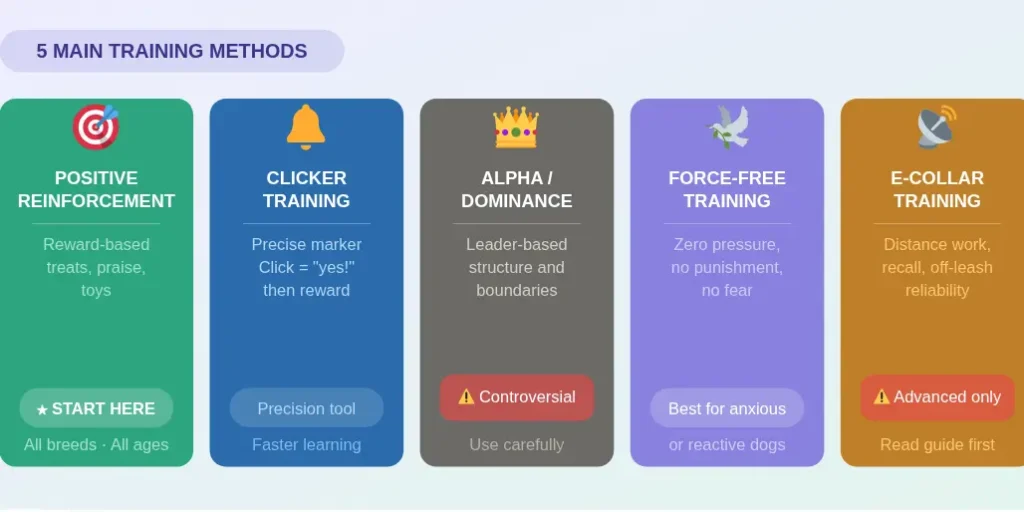
Not all dog training looks the same. Walk into ten different training classes and you might see ten different approaches — some using treats, some using clickers, some using e collars, some using nothing but patience and timing. Understanding the main methods before you start helps you choose the right approach for your dog, your lifestyle, and your goals. Here is an honest overview of each one.
1. Positive Reinforcement Training
Positive reinforcement training is a rewards-based method that teaches dogs by rewarding the behaviors you want to see more often. Rewards can include treats, praise, toys, play, or anything your dog finds genuinely motivating — and what motivates one dog may do nothing for another. A food-obsessed Labrador and a ball-obsessed Border Collie need completely different rewards for the same result.
This is one of the most widely recommended approaches by veterinarians and professional trainers because it focuses on building trust while helping dogs understand what earns a good outcome. It works well for basic obedience, manners, and behavior shaping at every age and breed.
Before committing to any trainer, it also helps to understand the broader dog training philosophy behind each method — not just the tools they use, but the beliefs that drive every decision they make.
For a deeper breakdown see our full guide to positive reinforcement training. To understand the science behind why it works, read our guide to operant conditioning in dog training.
2. Clicker Training
Clicker training is a form of positive reinforcement that uses a small clicking sound as a precise marker. The click tells the dog the exact moment they did the right thing and a reward follows immediately after. This precision makes training faster because the dog gets a clear signal instead of trying to guess which part of what they just did earned the reward.
The clicker itself is not the reward. It is a communication tool — a way of saying yes at exactly the right moment even when the treat takes a second to arrive. This is especially useful when teaching complex behaviors where timing makes all the difference.
To learn how to use it step by step read our full clicker training guide.
3. Alpha and Dominance Training
Alpha or dominance training is based on the idea that dogs need a strong leader and that behavior problems come from a dog attempting to assert control over the household. This method has become genuinely controversial. Many modern trainers and veterinary behavior experts debate or actively discourage parts of it — particularly techniques that rely on physical correction or intimidation.
The science behind dominance theory has been questioned significantly since it was first developed and much of it was based on studies of captive wolves that did not reflect how domestic dogs actually behave. Some owners still use leadership-based structure with good results but it should always be approached carefully and humanely.
Because this topic is widely misunderstood we cover it fully in our complete guide to Alpha Dog Training Method.
4. Force Free Training
Force free training avoids all punishment, intimidation, physical corrections, and tools designed to cause discomfort or fear. Where positive reinforcement rewards good behavior, force free training goes one step further by removing every form of pressure from the training environment entirely.
The difference matters most with nervous, reactive, or sensitive dogs. A dog that has learned to associate training with even mild discomfort will shut down, avoid, or become unpredictable. Force free training removes that risk completely. It can also work extremely well for everyday obedience and puppy training where you are starting from scratch with no fear to undo.
For examples of how it works in real situations see our full force free training guide.
5. E Collar Training
E collar training uses an electronic collar as a communication tool primarily for distance work, recall training, and off-leash reliability. Modern e collars offer adjustable levels of stimulation and when used correctly they can be effective for specific training goals that are difficult to achieve with treats alone — particularly with high drive working breeds at long distances.
However an e collar should never be treated as a shortcut or used to punish a dog without first teaching them what the signal means. Misused it creates stress, confusion, and can damage the relationship between dog and owner significantly. Timing, fit, and proper conditioning are everything with this tool.
Because the risk of misuse is real we strongly recommend reading our full e collar training guide before purchasing or using one.
The 10 Basic Commands Every Dog Must Know
Training your dog becomes significantly easier when you start with a clear foundation. These ten commands build good behavior, safety, and a genuine bond between you and your dog — and we cover every single one in detail in our complete basic dog commands list. These ten commands build good behavior, safety, and a genuine bond between you and your dog. They are listed here in the order most trainers recommend teaching them — starting with the most fundamental and building from there.
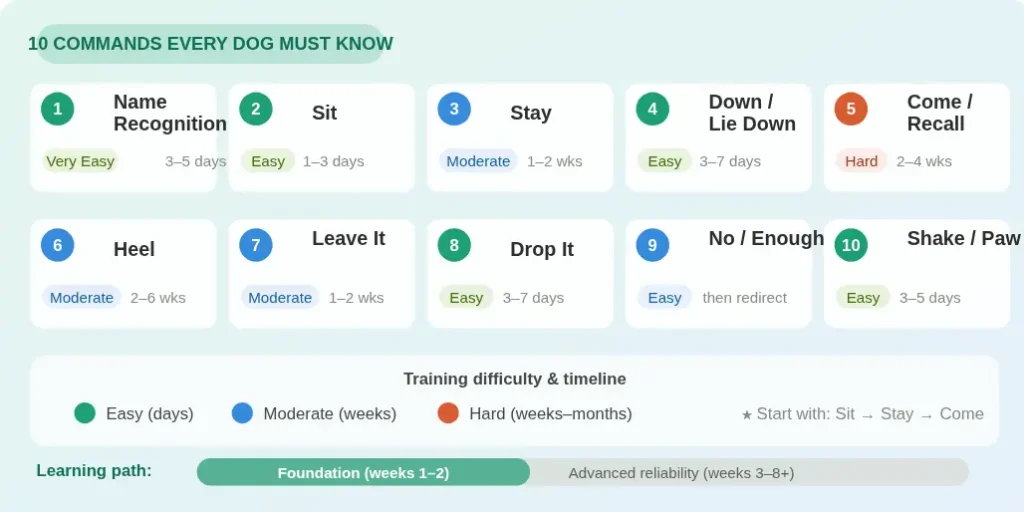
One thing worth knowing before you start. Most dogs can learn a basic version of any command on this list within one to two weeks of consistent daily practice. None of these require professional training to teach. What they require is patience, good timing, and a dog that is motivated by whatever reward works for them.
1. Name Recognition
Name recognition is the very first thing to teach any dog — before sit, before stay, before anything else. A dog that does not reliably respond to its name cannot follow any other command reliably either. Practice by saying your dog’s name once in a happy tone and immediately rewarding any eye contact or movement toward you. Within a few days most dogs respond consistently.
Difficulty: Very Easy. Timeline: 3 to 5 days.
See our full step-by-step guide: Name Recognition
2. Sit
Teaching your dog to sit is the foundation of everything that follows. It gives your dog a default behavior — something to do instead of jumping, running, or reacting. To teach it hold a treat above your dog’s nose and move it slowly back over their head until they naturally lower into a sit. Reward immediately. Most dogs pick this up faster than owners expect.
Difficulty: Easy. Timeline: 1 to 3 days.
See our full step-by-step guide: Sit
3. Stay
Stay builds on sit and teaches your dog patience and impulse control. It is essential for safety — a dog with a reliable stay will not bolt out of a door or run toward a road. Begin by asking your dog to sit then take one small step back. Return and reward before they move. Gradually increase distance and duration over several sessions.
Difficulty: Moderate. Timeline: 1 to 2 weeks.
See our full step-by-step guide: Stay
4. Down / Lie Down
The down command calms excitable dogs and builds genuine self control. A dog that can lie down on command in a busy or high energy environment is a dog you can take anywhere. Guide your dog from a sitting position into a lying position using a treat lured slowly toward the floor. Praise them the moment they are fully down.
Difficulty: Easy to Moderate. Timeline: 3 to 7 days.
See our full step-by-step guide: Down / Lie Down
5. Come / Recall
Recall is arguably the most important safety command a dog can know. It ensures your dog returns to you in any situation including emergencies. The key most owners miss — only call your dog when you can reward them generously. Never call your dog to tell them off or end their fun. A dog that learns come means something bad happens will stop coming.
I watched this play out at a local park once. An owner called their dog repeatedly — same word, same tone, over and over — and the dog did not even glance back. The owner had no treat, no toy, no reason for the dog to return. From everything I have since learned about recall training the reason was simple. That dog had never been taught that coming back meant something good. The word come was just a sound with no meaning attached to it yet.
Use a happy encouraging tone and a high value treat every single time your dog returns to you. Practice at short distances first and build from there over weeks.
Difficulty: Moderate to Hard. Timeline: 2 to 4 weeks for basic reliability.
See our full step-by-step guide: Come / Recall
6. Heel
Heel teaches your dog to walk beside you without pulling on the leash. It makes walks genuinely enjoyable rather than a daily battle your shoulder pays the price for. Start with short positive sessions and keep treats at your side to encourage your dog to stay close while walking. Reward frequently at first then gradually reduce.
Difficulty: Moderate. Timeline: 2 to 6 weeks depending on how established the pulling habit already is.
See our full step-by-step guide: Heel
7. Leave It
Leave it prevents your dog from grabbing dangerous or inappropriate items before they reach them. It teaches impulse control and can genuinely prevent accidents. Show a treat in your closed fist and say leave it. Wait. The moment your dog stops trying to get it and pulls back — reward with a different treat from your other hand. Never reward with the item you asked them to leave.
Difficulty: Moderate. Timeline: 1 to 2 weeks.
See our full step-by-step guide: Leave It
8. Drop It
Drop it is the companion command to leave it — where leave it prevents grabbing, drop it releases items already in the mouth. Offer a treat in exchange for the item while calmly saying drop it and praise your dog for letting go. Never chase your dog or pull items from their mouth — this turns it into a game and makes drop it harder to teach.
Difficulty: Easy to Moderate. Timeline: 3 to 7 days.
See our full step-by-step guide: Drop It
9. No / Enough
A general stop command helps set boundaries and interrupt unwanted behavior in the moment. One important note — on its own the word no tells your dog what not to do but nothing about what to do instead. For best results always follow it immediately with a command that redirects your dog to something appropriate. No, then sit. No, then down. The redirection is what does the real teaching.
Difficulty: Easy to teach. Moderate to use effectively.
See our full step-by-step guide: No / Enough
10. Shake / Paw
Shake is a confidence building command and one of the best tools for bonding. It requires your dog to offer a paw voluntarily — which builds trust and makes handling easier over time. Offer your open hand at paw height and wait. When your dog lifts their paw even slightly reward immediately. Build from there until they place their paw reliably in your hand.
Difficulty: Easy. Timeline: 3 to 5 days.
See our full step-by-step guide: Shake / Paw
How to Stop the 8 Most Common Dog Problem Behaviors
Problem behaviors are normal — especially when dogs are bored, stressed, under-trained, or simply unsure what you expect from them. Most issues are completely fixable with patient training, better management, and the right reward-based approach. The key is understanding why your dog is doing something before trying to stop it. A dog that barks from fear needs a completely different solution than a dog that barks from excitement. Getting the why right is half the battle.
Dogs that consistently ignore commands or resist responding are often labelled as difficult — but the behaviour has clear causes and solutions. For a deeper look, read our guide on how to train a stubborn dog.
For dogs whose problem behaviors are rooted in fear or anxiety our guide to reactive dog training covers the specific techniques that help build calmer responses over time.
1. Excessive Barking
Dogs bark to communicate excitement, fear, boredom, frustration, or alertness when something in their environment feels important to them. The mistake most owners make is reacting to the barking — shouting, rushing over, or even just looking at the dog — which the dog reads as attention and engagement regardless of whether it is positive or negative.
I have seen this happen more times than I can count — on streets near my home and at the local park. A dog spots someone walking past and erupts into barking. The owner pulls the leash and says quiet. The dog keeps going. The owner shouts. The dog barks harder. What that owner did not realise is that their shouting sounded exactly like barking to the dog. They were not calming the situation. They were joining it.
Start by identifying the specific trigger. Then reduce rehearsal by managing windows, visitors, noise, or outdoor access so the dog practices barking less. Reward quiet moments and teach an alternative behavior such as going to a mat or checking in with you.
Full guide: how to stop a dog from barking
2. Jumping Up
Dogs jump up because it gets attention, creates physical contact, and becomes self-reinforcing very quickly — even when people push them away or say no. The push and the no are still a reaction and reactions are what the dog is looking for.
Prevent jumping by keeping greetings calm and rewarding four paws on the floor before your dog receives any attention. Ask everyone in the household and every guest to do the same. Inconsistency across even one person undoes the training for everyone.
Full guide: how to stop a dog from jumping up
3. Pulling on the Leash
Dogs pull on the leash because moving forward is rewarding and the world outside is full of exciting smells, sights, and sounds that are genuinely more interesting than you are at that moment. The leash pulling works — it moves them forward — so they keep doing it.
Use management tools that give you control without causing pain then reward your dog consistently for staying near you. Stop or change direction the moment tension appears in the leash so pulling never earns forward movement again.
Full guide: how to stop a dog pulling on leash
4. Biting and Nipping
Dogs bite or nip during play, teething, overstimulation, or fear — or because they have simply never learned gentle mouth control. There is an important distinction between puppy mouthing which is soft, playful, and normal and serious biting which involves hard pressure, stiffness, a direct stare, or growling beforehand.
For normal mouthing redirect your dog onto toys, pause play the moment teeth touch skin, and reward calm interactions consistently. For serious repeated or aggressive biting — particularly if there are any of the warning signs above — work with a qualified trainer or behavior professional rather than attempting to manage it alone.
When biting stems from fear rather than habit, the approach changes significantly — our full guide to fear aggression in dogs covers the causes, warning signs, and step-by-step training strategies to help a fearful dog feel safe
Full guide: how to stop a dog from biting
5. Separation Anxiety
Dogs with separation anxiety panic when left alone because they genuinely feel unsafe without their person nearby. This is not stubbornness or spite. It is real distress and it needs to be treated as such.
Avoid sudden long absences and begin with very short departures your dog can handle calmly — sometimes as short as thirty seconds. Build independence gradually and pair alone time with something your dog finds comforting. Seek professional support if your dog is destructive, howling, or showing signs of physical distress when left alone.
Full guide: separation anxiety dog training
6. Resource Guarding
Dogs guard food, toys, beds, or people because they fear losing something they find valuable. This is a normal dog behavior that becomes dangerous when it escalates. The most important thing to understand here is that punishment makes guarding significantly worse not better. A dog that is punished for growling near their food bowl will eventually stop growling — and go straight to biting with no warning.
Instead manage access to high value items, teach trading games where approaching means something better is coming, and help your dog learn that people near their things predict good outcomes not loss.
Full guide: how to stop a dog from resource guarding
7. Digging
Dogs dig to burn energy, cool down, hunt smells, escape, hide items, or simply relieve boredom. Before trying to stop the digging ask what the dog is getting from it — because that tells you what they need instead.
Give your dog more exercise, mental enrichment, and supervision so digging is not their primary outlet for energy or stress. If they have a genuine love of digging consider creating an approved dig zone — a specific area of the garden they are allowed and actively rewarded for using. Most dogs transition to it quickly once they understand the rules.
Full guide: how do you stop dogs digging
8. Chasing Cats, Cars, and Cyclists
Dogs chase moving things because motion triggers prey drive, excitement, fear, or frustration depending on the individual dog. This is one of the most instinctive behaviors on this list and one of the most dangerous — a dog in full chase is not listening to anything.
Keep your dog on leash or behind secure barriers while training begins. Work on rewarding attention back to you at a safe distance from the trigger and teach a reliable recall before attempting any off leash work near moving objects. Reduce the distance to the trigger only when your dog can hold their focus on you consistently.
Food-related behaviors like begging at the table are just as disruptive as the eight above — and just as fixable. Our complete guide on how to stop a dog from begging covers exactly why it happens and how to resolve it for good.
Full guide: how to stop a dog chasing cats
Dog Training Tools: What You Actually Need and What You Don’t
You do not need expensive equipment to train a dog. I have seen this in my own neighbourhood. Someone got a new dog and within the first few weeks had bought almost every tool they came across — whatever a friend recommended, whatever looked good online, whatever the pet shop had on the shelf. Slip leads, harnesses, head collars, spray bottles, noise makers. The dog was still pulling on every walk and ignoring every command. The tools were not the problem and they were not the solution either. The missing piece was never the equipment. It was the knowledge of how to use any of it.
Start with the basics and add more only when you genuinely need them. Here are the five tools that actually make a difference.
1. Training Treats
Training treats are the single most important tool in dog training because they give your dog a clear and immediate reason to repeat good behavior. The key word is immediate — a treat that arrives five seconds after the behavior teaches your dog nothing. It needs to reach them within two seconds of doing the right thing.
Choose small soft treats your dog can swallow in one bite without stopping the session to chew. High value means something your dog finds genuinely exciting — usually something smelly, meaty, and different from their everyday food. A dog that works for their regular kibble during training is a motivated dog. A dog that turns their nose up at kibble needs something better.
For more options see our guide to the best dog training treats.
2. Clicker
A clicker is a small handheld device that makes a consistent clicking sound to mark the exact moment your dog does something right. It works better than voice alone because the click is always identical — the same pitch, the same volume, every single time — which makes it easier for your dog to understand than a human voice that changes depending on your mood.
The click is not the reward. It is the signal that tells your dog a reward is coming. That distinction matters because it means you can click at exactly the right moment even if the treat takes a second to reach them.
Learn the basics in our guide to dog training clicker how to use.
3. Training Collar
A training collar helps with safe handling, leash manners, and communication during walks. The right collar depends on your dog. Flat collars are best for everyday use on dogs that already walk well. Martingale collars work well for dogs with narrow heads who slip out of standard collars. Head collars can help strong pullers but must be introduced very gradually — a dog that is not used to a head collar will fight it and make walks worse not better.
Compare options in our guide to the best collar for dog training.
4. Long Line Lead
A long line lead is an extended leash typically between 10 and 30 feet that lets your dog explore and move freely while staying safely connected to you. It is one of the most underused tools in beginner training and one of the most valuable — particularly for recall practice where you need your dog to learn to come back from a distance without the risk of them running off completely.
Most dogs that struggle with recall have simply never practiced it at distance. A long line solves that problem safely.
Start here with our guide to long line dog training leads.
5. Training Pouch
A training pouch keeps treats accessible so you can reward good behavior the exact moment it happens. This matters more than most owners realise. If you have to dig through your pocket to find a treat you have already missed the two second window. Hands-free access means your timing stays sharp during walks, recall practice, and loose leash training.
See useful options in our guide to the best dog training pouch.
6. Dog Whistle
A dog whistle is particularly useful for recall training at long distances. The sound carries much further than a human voice and remains consistent regardless of how calm or frustrated you are feeling in the moment — which matters because dogs read your emotional state through your voice. A whistle sounds the same whether you are relaxed or panicking.
It is not essential for beginners but becomes genuinely valuable once your dog has a solid foundation in basic recall.
Learn how to use one in our dog whistle training.
What Not to Buy
Avoid buying training tools you do not need yet. Prong collars, e collars, slip leads, and head collars all have specific uses but in the wrong hands or used too early they create new problems rather than solving existing ones. Start with treats and a clicker. Add other tools only when your training progresses to a point where you genuinely understand what each tool does and why.
Should You Hire a Dog Trainer? Here’s How to Decide
Hiring a professional trainer is not admitting defeat. In fact knowing when to ask for help is one of the most responsible things you can do as a dog owner. Some problems are simply bigger than YouTube tutorials and good intentions — and the sooner you recognise that the better it is for you and your dog.
I have seen what happens when that recognition never comes. A friend’s cousin has been dealing with the same aggression and barking problem for years. Every time the dog acted up they punished it. Shouted, physical correction, whatever felt like it should work in the moment. Years later the problem is exactly the same. Not better. Not worse. Just years of frustration that a qualified behaviourist could likely have resolved in a matter of weeks. The punishment never taught the dog what to do instead. It only taught the dog to be more anxious about the situations that triggered the behaviour in the first place.
Three Signs It Is Time to Call a Professional
Sign 1 — Your dog is showing aggression. If your dog is growling, snapping, or lunging at people or other dogs please do not try to handle that alone. Aggression has underlying causes that need proper assessment and getting it wrong can make things significantly worse. This is not a YouTube tutorial situation. This is a qualified behaviourist situation.
Sign 2 — Your dog has severe anxiety. Whether that is separation distress, fear-based reactivity, or deep rooted phobias — basic obedience training will not touch it. These dogs need a structured behaviour modification plan from someone who genuinely understands what is driving the anxiety, not just what it looks like on the surface.
Sign 3 — You have been trying for months with nothing to show for it. If you are consistent, patient, doing everything right by every guide you have read — and nothing is improving — a professional can often identify the problem within a single session. Sometimes the issue is so subtle that only a trained eye can spot it. That one session can save you months of frustration.
How to Choose the Right Trainer
Be selective. Qualifications matter — bodies like the CCPDT and IAABC set real professional standards. Ask any trainer upfront what methods they use. Reward based positive reinforcement training has the evidence behind it. If someone reaches for a prong collar or talks about dominance before they have even assessed your dog properly — walk away.
See our full guide: things to ask before hiring a dog trainer
Group Classes or Private Sessions?
Group classes work well for puppies, socialisation, and foundation obedience in a low stakes environment. Private sessions are worth the extra cost if your dog has anxiety, reactivity, or aggression — too many distractions in a group setting can undo progress faster than it builds it.
See our full comparison: group dog training vs one to one
How Much Does It Cost?
One to one sessions typically run £40 to £100 per session. Group classes are usually £10 to £20. It adds up — but so does ignoring a problem that gets harder and more expensive to fix the longer it goes on. A dog with untreated aggression or severe anxiety does not get better with time alone.
For a full breakdown see: dog training cost how much
If budget is a genuine barrier structured online courses are a legitimate alternative for owners working on foundations and general obedience. They are flexible, often surprisingly thorough, and significantly cheaper than private sessions. The main thing you lose is someone watching your technique in real time — which matters more for complex behavior problems than for basic training.
See our guide: online dog training courses worth it
And if you are weighing up the full cost of professional support alongside other dog services our guide to how much a dog walker costs gives useful context on budgeting for dog care overall.
Does Dog Training Change by Breed? Yes — Here’s What to Know
The core commands — sit, stay, come, leave it — work for every dog regardless of breed. But how easily your dog learns them, how motivated they are, what rewards actually work, and what problems come up along the way — that depends enormously on breed.
Personality, energy level, and instinct vary so widely between breeds that a method which clicks instantly for one dog can completely miss with another. This is not about intelligence. Some of the hardest breeds to train are also some of the most intelligent — they are just intelligent in ways that do not naturally align with what humans want from them.
Three breeds that show just how different training can be:
Border Collie — Bred to work all day making independent decisions. Without consistent mental stimulation they will find their own jobs to do — and you will not like what they choose. Border Collies need training that challenges their mind not just their body.
Husky — Strong willed and bred to run long distances away from their owner. Recall training requires extra time and consistency because Huskies were specifically developed to make independent decisions at distance. They are not being stubborn — they are being exactly what they were bred to be.
Golden Retriever — Natural people pleasers who pick up commands quickly and respond exceptionally well to positive reinforcement. One of the most beginner friendly breeds for first time owners which is partly why they are so consistently popular.
The differences go deeper than just how fast a breed learns. They affect which rewards work, how long sessions should run, how much independence the dog naturally wants, and what the most common pitfalls are for each breed. A Beagle will follow its nose before it follows you. A French Bulldog can overheat quickly during training sessions. A German Shepherd needs consistent leadership or it will fill the gap itself.
Our breed specific guides cover all of it in detail.
Browse our breed specific training guides:
- Training a Border Collie
- Training of German Shepherds
- Training of Golden Retrievers
- Siberian Husky Training
- Training Beagles
- Training French Bulldogs
- Training Labrador Retrievers
- Training Cavalier King Charles Spaniels
Do not see your breed? We have guides for over 45 breeds — browse the full list here.
Start Training Your Dog Today — Conclusion
This guide walked you through the core principles of dog training — from understanding how dogs learn to building the daily habits that make training stick. You now have a clear picture of what effective training looks like and the tools to make it happen with your own dog.
Remember: consistency matters far more than perfection. Short, regular sessions beat occasional marathon training days every time. Every well-trained dog started exactly where yours is now — a little confused, a little distracted, and full of potential.
Now it is time to take action. Start with the sit command — it is the foundation everything else is built on. Follow our step-by-step guide here: [how to teach a dog to sit]
Your dog is ready to learn. The only thing left is for you to begin.
Frequently Asked Questions About Dog Training
How long does it take to train a dog?
Most dogs learn basic commands within 4 to 8 weeks of consistent training. However, the total timeline depends on the dog’s age, breed, temperament, and the complexity of the behaviors you’re teaching. A puppy starting from scratch may reach a solid foundation in two to three months, while mastering advanced obedience can take six months to a year. Daily repetition and patience are the biggest factors — short, focused sessions consistently outperform sporadic marathon training days every time.
How many times a day should you train a dog?
Two to three short training sessions per day is the optimal frequency for most dogs. Each session should last between five and fifteen minutes — long enough to make progress, short enough to keep your dog engaged and mentally sharp. Puppies and younger dogs fatigue quickly, so three brief sessions work better than one long one. Spreading sessions throughout the day also reinforces learning at different energy levels. [→ Learn more: how many times a day should you train a dog]
At what age is a dog too old to train?
There is no age at which a dog becomes truly too old to learn new behaviors. The saying “you can’t teach an old dog new tricks” is simply a myth — senior dogs are absolutely capable of learning, though they may require more repetitions and patience. Cognitive function and physical ability may slow things down, but the fundamentals of positive reinforcement work at every life stage. In fact, mental stimulation from training is genuinely beneficial for aging dogs’ brain health and overall wellbeing. [→ Learn more: at what age is a dog too old to train]
Is it too late to train my dog?
It is never too late to start training your dog, regardless of age or past behavior. Adult and senior dogs can absolutely learn new commands, break old habits, and improve their manners with the right approach. Older dogs often have longer attention spans than puppies, which can actually make training easier. The key is using consistent, reward-based methods and setting realistic expectations around the pace of progress. Even small improvements in behavior can dramatically improve the quality of life for both dog and owner. [→ Learn more: is it too late to train my dog]
How much does dog training cost?
Dog training costs vary widely depending on the format, trainer experience, and your location. Group obedience classes typically run $50 to $125 for a multi-week course, while private in-home sessions range from $75 to $300 per hour. Board-and-train programs, where your dog stays with a trainer, can cost anywhere from $1,000 to $2,500 or more. Online training programs offer a more affordable option, often between $25 and $100. The best investment is one that fits your schedule and your dog’s specific behavioral needs. [→ Learn more: dog training cost how much]
What is the first thing you should train a dog?
The first command you should teach a dog is “sit,” as it forms the foundation for nearly every other behavior. Sit is simple, achievable quickly, and gives your dog an immediate way to communicate with you for rewards — establishing that training is a positive experience. From sit, you can build “stay,” “down,” and “leave it” much more naturally. Teaching a reliable recall (come when called) should also be prioritized early, as it is one of the most important safety behaviors your dog will ever learn.
What is the hardest dog command to teach?
“Stay” — especially at a distance with distractions — is widely considered the most difficult command to fully proof. While many dogs learn the basic concept quickly, a truly reliable stay requires building duration, distance, and distraction resistance in careful, incremental steps. “Heel,” which asks a dog to walk calmly at your side regardless of environment, is another notoriously challenging skill. Both commands require far more training sessions than simple cues like sit or shake. The difficulty lies not in initial learning, but in making the behavior dependable in real-world situations.