You know your dog should sit, stay, and come when called. But when you actually try to teach them, nothing seems to stick. This is the complete basic dog commands list — every command your dog needs, in the order to teach them, with exactly how to teach each one.
Whether someone has just welcomed a new puppy into their home or adopted an older dog, the right approach to dog training can completely transform the relationship between owner and pet. This guide covers a practical, well-organised list of dog commands — from the essential basics to more advanced skills — along with clear, step-by-step guidance on how to teach each one.
If you are completely new to training start with our complete dog training guide for beginners before working through the commands below.
Why Do Dog Training Commands Matter So Much?
Dog training is not simply about control — it is about creating a shared language between a dog and its owner. Every time an owner uses the same command consistently, the dog begins to associate that word with a specific action. Over time, this makes the dog feel more secure and confident, because it knows exactly what is expected of it.
A well-trained dog is also a much safer dog. Essential dog training commands help prevent genuinely dangerous situations — stopping a dog from dashing into traffic, jumping on vulnerable visitors, or reacting unpredictably in public. Beyond safety, training builds trust and makes daily life far more enjoyable for the whole household. The key is staying consistent, keeping training sessions upbeat, and always rewarding progress.
What Commands Should Every Dog Know?
Every dog should know a core set of commands that cover the most common everyday situations. These are the commands that professional dog trainers and veterinary behaviourists consistently recommend, regardless of a dog’s breed, size, or age.
The essential dog commands that form this foundation include: Sit, Stay, Come, Heel, Down, Leave It, No, Off, and Place. Together, this list of commands gives owners a reliable, calm way to communicate with their dog in almost any situation — at home, on walks, or out in public. Mastering these basic dog training commands sets every dog up for a happy, well-adjusted life.
What Are the Basic Dog Training Commands and How Are They Taught?
1. “Sit” — The First Command to Teach Your Dog
The sit command is widely considered the best command to teach your dog first, and for very good reason. It is simple to learn, quick to reward, and it forms the foundation for many other skills that follow. Most professional dog trainers recommend starting here because early success builds the dog’s confidence and eagerness to keep learning.
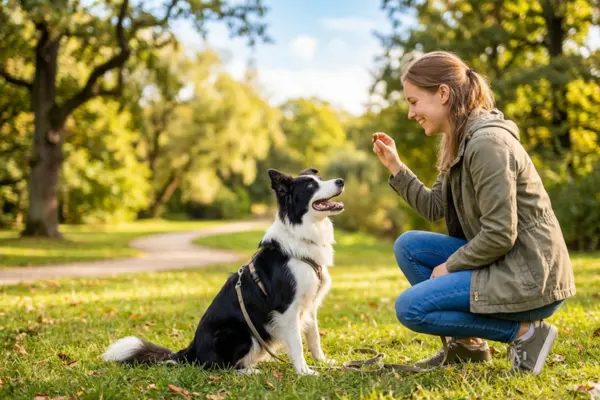
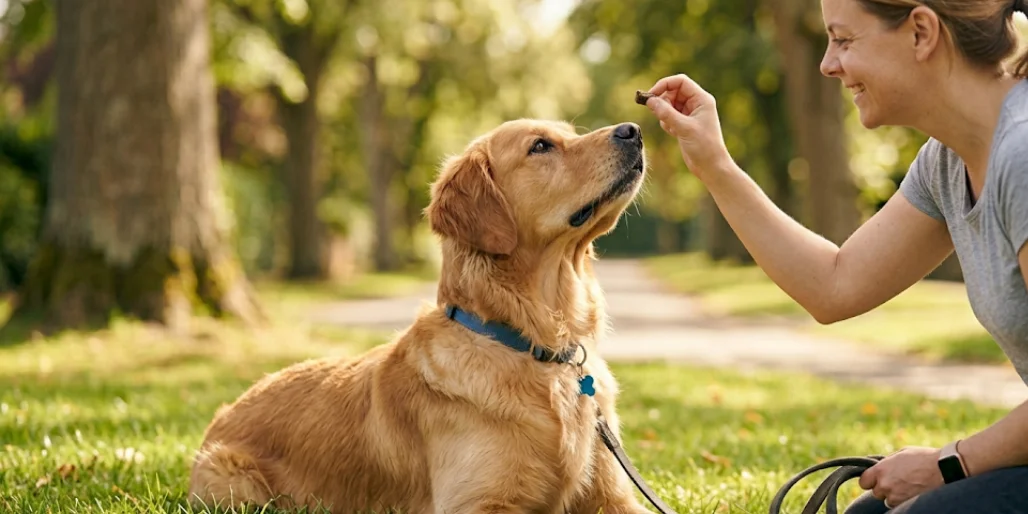
To teach this command, the owner holds a treat in hand close to the dog’s nose, then slowly lifts it upward. As the dog follows the treat with its nose, its bottom naturally lowers toward the ground. The moment the dog reaches a full sitting position, the owner should say the command clearly, then give them the treat immediately. With enough repetition, the dog will begin to sit the moment it hears the word — even without a treat in hand.
It is important to say the command only once and then wait. If the owner repeats the word several times before the dog responds, the dog learns it does not need to act straight away — which slows the entire training process down considerably.
2. “Stay” — Building Patience and Impulse Control
Once a dog has got the hang of “sit,” “stay” is the logical next step. This command is essential because it teaches the dog to hold its position even when the owner moves away or distractions appear nearby. It is a command that is used constantly in real life and one that directly supports the dog’s overall self-control.
To teach “stay,” the owner first asks the dog to sit. Then, with an open palm facing the dog, they say “stay” clearly and take one step back. If the dog holds its position, the owner returns, praises it warmly, and gives them a treat. Over several training sessions, the distance and duration are gradually increased.
Whether a dog gets close to an open gate, a busy road, or a crowded public space, “stay” gives the owner a reliable, calm way to hold the dog in place until the situation is safe. This command is crucial — and it is one no dog should go without.
3. “Come” — A Command That Could Genuinely Save a Life
The recall command — “come” — is one of the most important commands in any dog’s vocabulary, particularly in off-leash settings. It tells the dog to return to the owner immediately and reliably, no matter what else is going on around it.
Teaching “come” works best in a quiet, low-distraction environment to begin with. The owner crouches down, opens their arms, and says “come” in a warm, enthusiastic tone. When the dog reaches the owner, it receives big praise and a reward — something the dog genuinely loves. This command must always be associated with something positive. If a dog is ever called to come and then scolded, it quickly learns to avoid coming when called, which defeats the entire purpose.
Over time, the owner practises this command on a long leash before moving to true off-leash situations. Reliable recall is the single most important safety skill a dog can have.
4. “Heel” — Walking Calmly on the Leash
Leash pulling is one of the most common frustrations dog owners face, and the heel command addresses it head-on. When a dog heels, it walks steadily beside the owner — not pulling ahead, not lagging behind, and not straining at every distraction.
To teach this command, the owner starts with the dog on the leash on their preferred side, holding a treat at hip level. As they begin walking, the dog is rewarded for staying beside them and matching their pace. If the dog pulls ahead, the owner stops completely — forward movement only resumes once the leash is slack again. Consistency here is everything.
The heel command is especially important on busy streets, in vet waiting rooms, and in parks, where a dog pulling on the leash can create real hazards. Many trainers note that once a dog reliably heels, it becomes noticeably calmer overall — because it is focused on the owner rather than reacting to everything around it. The heel cue can also be reinforced with a hand signal, which is especially useful in loud environments or as the dog gets older.
5. “Down” — Settling the Dog in Any Situation
The “down” command tells the dog to lie completely flat on the ground. It is useful across a wide range of everyday situations — from keeping the dog calm during mealtimes to settling it when guests arrive or when the owner needs a moment of quiet.
To give the command effectively, the owner starts with the dog sitting. A treat is held at nose level and then guided slowly straight down toward the floor and slightly forward, so the dog follows it naturally. As the dog’s nose tracks the treat downward, its elbows drop to the ground. The moment the dog is fully down, the owner says “down” and gives them a treat straight away.
This command is often considered harder than “sit” because lying down places a dog in a more exposed, vulnerable position. Some dogs resist it at first. Patience and consistent positive reinforcement are what make the difference over time.
6. “No” and “Leave It” — Redirecting Unwanted Behaviour
Every dog owner needs a reliable way to tell their dog that something is off-limits. The ability to say “no” — or use the “leave it” cue — is an important command that serves as the owner’s clearest boundary-setting tool.
To teach “leave it,” the owner places a treat on the floor and covers it with their hand. When the dog sniffs, nudges, or paws at the hand, the owner simply waits. The moment the dog pulls back or looks away, it is immediately rewarded with a different, better treat from the other hand. Over time, the dog learns that ignoring the forbidden item leads to something even more rewarding — and the behaviour becomes reliable.
This cue is deeply practical. It can stop a dog from snatching something dangerous off the ground during a walk, eating something harmful at home, or approaching another dog or person in an unwanted way.
7. “Off” — No More Jumping Up
Jumping up is entirely natural dog behaviour — dogs instinctively want to greet people at face level. However, it becomes a problem quickly, especially around children, elderly guests, or anyone who is not comfortable around dogs.
The “off” command teaches the dog to keep all four paws on the floor. When the dog jumps, the owner turns away, removes all eye contact, and says nothing — taking away all attention entirely. The moment the dog has all four paws back on the ground, it receives calm praise and a reward. Consistency is the most important part of teaching this command; every person in the household must respond the same way.
It is worth being clear that “off” and “down” are two separate commands. “Down” means lie flat; “off” means get off a person or a piece of furniture. Keeping these distinct avoids confusion and helps the dog respond correctly to each one.
How Can Owners Build a Reliable Heel and Strong Leash Skills?
How Do You Train a Dog to Heel in Distracting Environments?
Many dog owners find that the heel command requires more ongoing work than others — simply because real-world walks involve constant distractions. Other dogs, cyclists, birds, interesting smells — all of these compete for the dog’s attention and can break focus in an instant.
The trick to teach your dog to heel reliably is to progress through environments gradually. Start indoors, then move to the garden, then to quiet streets, and finally to busier areas. Each new level should only be introduced once the dog is consistent at the previous one. Using the same cue every single time — whether a word, a sound, or a hand signal — helps the dog understand exactly what is being asked of it.
Some owners find that turning in the opposite direction when the dog pulls is more effective than stopping, as it actively redirects the dog’s attention back to the owner rather than simply pausing forward progress.
What Does Good Leash Training Look Like Beyond Heeling?
Leash skills go beyond just heeling. A dog should be comfortable having the leash clipped on, should not bolt through open doors, and should be able to walk calmly past other dogs and people without reacting. These are all part of the broader leash training picture.
Starting leash training early — even with a very young puppy — sets habits that become deeply ingrained with time. A well-structured leash training approach helps owners keep your dog safe and makes daily walks something both the dog and the owner genuinely look forward to, rather than something to dread.
What Advanced Commands and Tricks Can Dogs Learn Next?
Are Advanced Commands Worth Teaching After the Basics?
Once the foundational commands are solid and reliable, advanced commands open up a whole new level of engagement between a dog and its owner. Advanced tricks like “roll over,” “spin,” “shake,” and the place command challenge the dog’s mind, keep training sessions interesting, and deepen the connection between dog and owner.
The place command, for example, instructs the dog to go to a specific mat or bed and stay there until released. This command is essential for managing dog behaviour during mealtimes, when deliveries arrive, or simply when the owner needs the dog to settle in one defined spot. It takes time to teach this command well, but once mastered, it becomes one of the most useful tools in a dog owner’s toolkit.
Another command worth introducing at this stage is the verbal command for things like “wait” at doors or “leave it” around food. These build directly on the dog’s existing knowledge and reinforce the idea that every command is used to help the dog navigate the world safely.
What Is a Fun Trick to Teach Your Dog Once the Basics Are Solid?
One particularly enjoyable and fun trick to teach your dog is the spin. The owner holds a treat at the dog’s nose level and slowly guides it in a full circle — the dog follows the treat with its nose and naturally turns around. Once the dog does this consistently, the owner introduces the verbal command and gradually fades out the hand lure.
Tricks like spin are a great way to continue building a dog’s confidence and mental sharpness after the essential commands are well-established. They also make for a great way to show your dog some extra attention and fun — and they tend to delight anyone watching.
What Tips Help Make Dog Training Actually Work?
Do Short Training Sessions Really Make a Difference?
Yes — and this is one of the most consistent pieces of advice from any experienced dog trainer. Dogs, especially puppies, have short attention spans, and long sessions tend to lead to frustration rather than learning. Five to ten minutes of focused, energetic training done several times throughout the day is far more effective than a single drawn-out session.
Ending every session on a positive note — with a command the dog already knows well, followed by enthusiastic praise — means the dog walks away feeling successful. That positive association makes it eager to train again next time.
Why Is Consistency So Important When You Train Your Dog?
Dogs do not process language the way humans do. They learn through repetition, timing, and association. If different family members use slightly different words — “sit,” “sit down,” “sit, boy” — the dog may struggle to connect any of them to a clear action. Every person in the household should use the same command, the same cue, and the same reward approach every time.
Positive reinforcement — rewarding the dog every time it performs a behaviour correctly — is consistently the most effective training method. Punishment-based approaches can create anxiety and erode trust, making dog behaviour worse over time rather than better. Reward-based training, on the other hand, keeps the dog engaged, willing, and happy.
When Should Dog Owners Seek Professional Help?
If a dog consistently struggles with commands, shows signs of anxiety, or displays aggression that does not respond to training, it is time to consult a professional dog trainer. A qualified trainer can identify exactly what is going wrong in the training process, assess the dog’s individual needs, and offer guidance that is tailored to that specific dog and household.
It is important to start teaching commands as early as possible — but it is never too late to get help, begin again, or try a different approach. Many dogs that seemed “untrainable” have gone on to become calm, reliable companions once the right support was found.
Final Thoughts: Building a Well-Behaved Dog One Command at a Time
Training a dog is not a single event — it is an ongoing, evolving process of communication, consistency, and connection. The core commands covered in this guide — sit, stay, come, heel, down, off, no, and place — form a solid foundation that every dog should know, and that every owner can realistically teach with patience and the right approach.
From there, the journey continues. Advanced commands, better leash skills, and fun new tricks all help your dog stay mentally active and strengthen the bond between dog and owner. Every dog should know these basics, and every training session is a fresh opportunity to communicate with your dog in a way that is clear, kind, and rewarding for both of you.