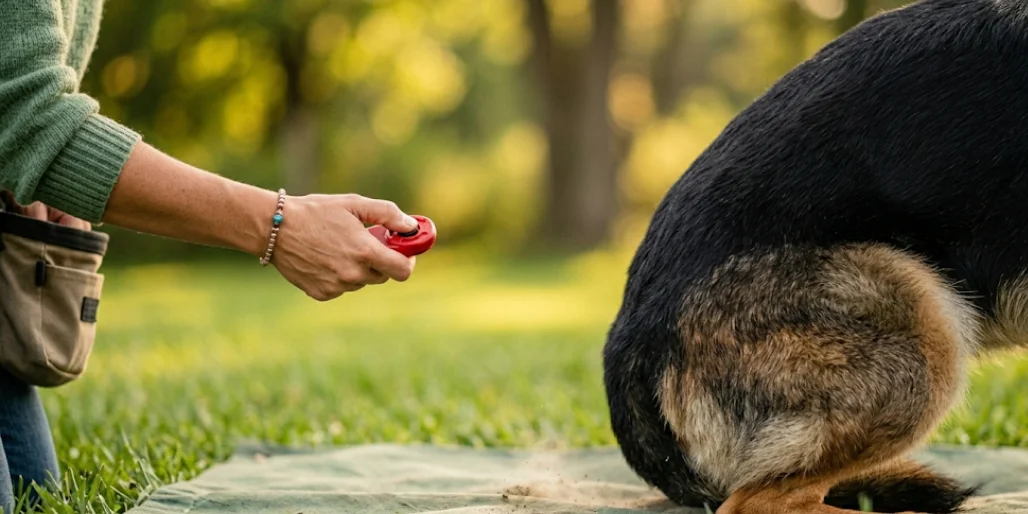
Looking to build a stronger bond with your furry friend while teaching them new tricks? Clicker training might just be the perfect solution! This engaging and effective method harnesses positive reinforcement to shape your pet’s behavior in a fun and rewarding way. Get ready to discover the secrets behind this popular training technique.
Understanding Clicker Training
What is Clicker Training?
Clicker training is a science-based training method that utilizes a distinct clicking sound to mark the exact moment your pet performs a desired behavior. It’s a powerful form of positive reinforcement training that teaches your dog or other animal what they are doing right. This method, popularized by pioneers like Karen Pryor, is incredibly effective for teaching new behaviors quickly and clearly — see how it fits within the broader spectrum of approaches covered in our dog training guide.
Benefits of Using Clicker Training
There are numerous benefits to using clicker training, making it a favorite among dog trainers and pet owners alike. The precision of the clicker allows you to communicate exactly what behavior you want, which speeds up the learning process and reduces frustration for both the trainer and the pet. This method strengthens the bond between you and your animal by creating a positive and engaging training environment, promoting eagerness and enthusiasm in your pet during training sessions.
How Clickers Work in Training
The clicker works as a conditioned reinforcer, meaning the clicking sound itself becomes associated with a reward. The first step in clicker training is to teach your dog to associate the clicker sound with something positive, typically a small, high-value treat. When you click the clicker at the precise moment your dog exhibits the desired behavior, you immediately follow up with a treat. This “click and treat” sequence helps your dog understand that the clicking sound means they did something correctly, making them more likely to repeat that action in the future.
Getting Started with Clicker Training
Choosing the Right Clicker
When you first start to clicker train, selecting the right clicker is a small but important decision. While the fundamental function of all clickers is to produce a consistent clicking sound, there are various designs available, and finding one that feels comfortable and is easy for you to operate is key for effective dog training. Some clickers are box-shaped, while others are stick clickers, or even integrated into a wristband, allowing for hands-free operation which can be super helpful when you’re trying to manage treats and a leash. The most important thing is that the clicker produces a clear, distinct sound that your pet can easily distinguish, and that you can activate it precisely at the exact moment your pet performs the desired behavior.
Preparing for Training Sessions
Before you even begin to clicker train, a little preparation goes a long way in setting yourself up for success. First and foremost, gather plenty of small, high-value treats that your pet absolutely adores; these will serve as your primary positive reinforcement. Break them into tiny pieces so you can offer several rewards without overfeeding your pet. You’ll also want to have your clicker readily accessible. Make sure you’re in a calm, focused mindset, ready to engage positively with your pet. Remember, the goal of using a clicker is to make training a fun and rewarding experience for both of you, so bringing a good attitude is crucial for these initial training sessions.
Setting Up a Training Environment
Creating an optimal training environment is essential for effective clicker training, especially when you are teaching a new behavior. Begin by choosing a quiet space with minimal distractions where your pet can focus entirely on you. This might be a calm corner of your living room, or a fenced backyard if you’re training outdoors, away from other animals or exciting smells. Ensure the area is safe and free of anything that might tempt your pet away from the training. A clutter-free zone helps your dog to sit and focus on the task at hand, making it easier for you to capture and reinforce the specific behavior you want with the clicker. As your pet progresses, you can gradually introduce more distractions.
Techniques for Effective Clicker Training
Basic Commands to Teach Using Clickers
Once your pet understands that the clicking sound means a treat is coming, you’re ready to start teaching a new behavior using clicker training. Simple commands like “sit,” “stay,” or “come” are excellent starting points for dog training. To teach your dog to sit, for example, you might gently lure your dog into a sitting position with a treat, and the exact moment their rear touches the ground, click the clicker and immediately follow with a treat. This “click and treat” sequence helps your dog associate the action of sitting with the positive reinforcement, and with enough repetition, they will quickly learn the desired behavior. The goal is to get your dog to offer the behavior voluntarily before you even introduce a verbal cue.
Timing Your Clicks for Success
Timing is absolutely everything when you clicker train. The effectiveness of clicker training uses the clicker as a precise marker of the desired behavior, so clicking at the exact moment your pet performs the action is crucial. If you click too early or too late, your pet might become confused about what action earned them the reward, hindering the learning process. The clicker is used to capture the behavior, acting as a clear “yes!” signal that tells your pet, “That’s exactly what I wanted!” For instance, when teaching your dog to sit, you need to click the clicker the instant their bottom touches the floor, not a second before or after, ensuring they understand the connection between their action and the positive reinforcement.
The American Kennel Club (AKC) also emphasises that clicking at the exact moment your pet performs the action is the single most important factor separating effective clicker training from confusing it.
Reinforcing Behavior Through Clicker Training
Reinforcing behavior through clicker training is all about building a strong association between the desired action, the clicking sound, and the reward. After your dog consistently performs a behavior, you can start to introduce a verbal cue or a hand signal. Say the cue (e.g., “sit”) just before your dog performs the action, then click and give a treat the moment they execute it. Gradually, your dog will associate the cue with the action. Once your dog knows the command, you can start to phase out the clicker and rely solely on the verbal cue and occasional treats or praise, maintaining the positive reinforcement that makes clicker training so effective.
Common Challenges in Clicker Training
Dealing with Distractions During Training
Even the most seasoned clicker trainers face the challenge of distractions during training sessions. When you first start to clicker train, it’s crucial to begin in a quiet, distraction-free environment, but as your pet progresses, you’ll want to gradually introduce more real-world scenarios. If your dog is easily distracted by sounds, smells, or other animals, it can be tough to get them to focus on the desired behavior. The key is to manage the environment carefully, starting with low-level distractions and slowly increasing them. This helps your pet learn to perform the behavior you want, regardless of what’s going on around them, solidifying their understanding of the cue.
When Your Pet Doesn’t Respond to the Clicker
It can be frustrating when your pet doesn’t seem to respond to the clicker, but this usually points to a few common issues that can be easily addressed. Often, the first step in clicker training, which is associating the clicking sound with a positive reinforcer, hasn’t been fully established. Make sure you are consistently pairing the clicker sound with a high-value treat every single time, without fail. Sometimes, the treats aren’t motivating enough, or the timing of the clicker is off. Go back to basics, ensure your timing is precise, and use irresistible rewards. With patience and consistency, your pet will soon understand that the clicker means “yes, you did it right!”
Adjusting Techniques for Different Pets
One of the beautiful aspects of positive reinforcement training is its adaptability, but it’s vital to remember that not all pets learn at the same pace or in the same way. What works perfectly for teaching a dog to sit might need tweaking for a cat or a bird. Some pets are highly food-motivated, while others might prefer a favorite toy or verbal praise as their reinforcer. A good dog trainer understands that observing your individual pet’s personality, energy levels, and learning style is crucial. You might need to adjust the duration of your training sessions, the type of treats, or even the complexity of the new behavior you’re teaching to ensure continued success and engagement.
Advanced Clicker Training Techniques
Using Clickers for Tricks and Complex Behaviors
Once your pet has mastered basic commands, using clickers to teach your dog tricks and more complex behaviors becomes incredibly rewarding, and pairing the clicker with a dopamine box can take that engagement even further for high-drive dogs. Advanced clicker trainers often use a technique called “shaping,” which involves breaking down a complex action into smaller, achievable steps. For instance, if you want to teach your dog to get a specific item, you might first click and treat for looking at the item, then for moving towards it, then for touching it with their paw, and so on. The precision of the clicker allows you to mark each tiny step in the right direction, building up to the complete desired behavior with clear communication and positive reinforcement.
Incorporating Clicker Training into Daily Routines
Clicker training isn’t just for formal training sessions; it can be seamlessly incorporated into your daily routines to reinforce good behavior and strengthen your bond. Imagine using a clicker to reward your dog for calmly greeting guests at the door, rather than jumping up, or for settling down quietly when you’re busy. This constant positive reinforcement helps to generalize behaviors, meaning your pet understands that performing the desired behavior is rewarding in various contexts, not just during dedicated training time. By consistently using a click and treat, you’re constantly communicating what you like, making good behavior a regular and enjoyable part of your pet’s life.
Evaluating Progress and Adjusting Goals
Regularly evaluating your pet’s progress is a cornerstone of effective clicker training and helps you adjust your goals to keep training engaging and productive. Are they consistently performing a new behavior with the cue? Are they still enthusiastic about the training sessions? If your pet seems bored or frustrated, it might be time to either simplify the task or introduce a new, more challenging one. Don’t be afraid to revisit simpler steps or change your reinforcer if needed. The beauty of clicker training lies in its adaptable approach, allowing the trainer to constantly refine their methods and objectives to ensure both you and your pet continue to enjoy the learning journey together.