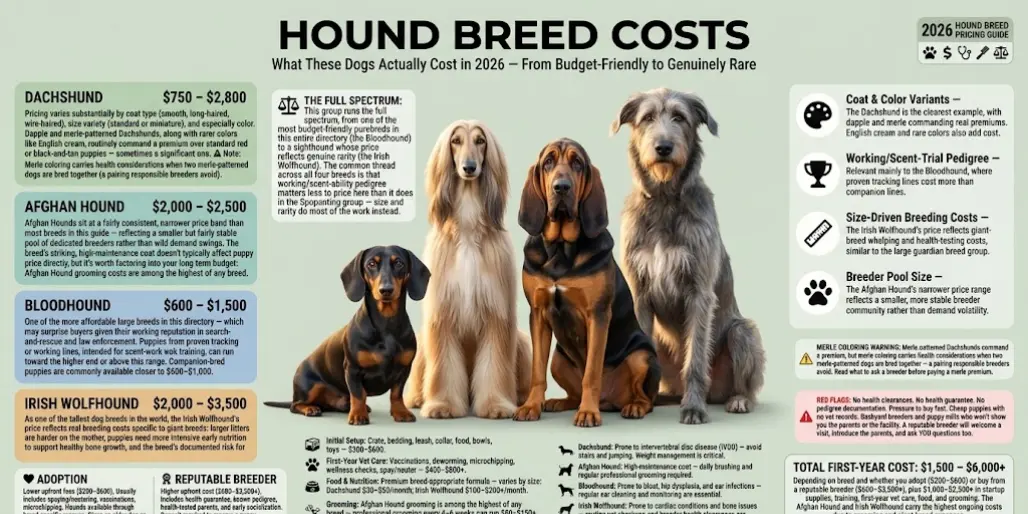
This group runs the full spectrum, from one of the most budget-friendly purebreds in this entire directory (the Bloodhound) to a sighthound whose price reflects genuine rarity (the Irish Wolfhound). The common thread across all four breeds is that working/scent-ability pedigree matters less to price here than it does in the Sporting group, size and rarity do most of the work instead.
Part of the Dog Breed Cost Guides directory.
Dachshund Cost
Typical price range: $750–$2,800
Dachshund pricing varies substantially by coat type (smooth, long-haired, or wire-haired), size variety (standard or miniature), and especially color, dapple and merle-patterned Dachshunds, along with rarer colors like English cream, routinely command a premium over standard red or black-and-tan puppies, sometimes a significant one. Because merle coloring carries its own health considerations when two merle-patterned dogs are bred together (a pairing responsible breeders avoid), it’s worth reading what to ask a breeder before paying a merle premium before you fall for the color alone.
Afghan Hound Cost
Typical price range: $2,000–$2,500
Afghan Hounds sit at a fairly consistent, narrower price band than most breeds in this guide, which reflects a smaller but fairly stable pool of dedicated breeders rather than wild demand swings. The breed’s striking, high-maintenance coat doesn’t typically affect puppy price directly, but it’s worth factoring into your long-term budget, Afghan Hound grooming costs are among the highest of any breed.
Bloodhound
Typical price range: $600–$1,500
Bloodhounds are one of the more affordable large breeds in this directory, which may surprise buyers given their working reputation in search-and-rescue and law enforcement contexts. Puppies specifically from proven tracking or working lines, intended for scent-work training, can run toward the higher end or above this range, while companion-bred puppies are commonly available closer to $600–$1,000.
Irish Wolfhound
Typical price range: $2,000–$3,500
As one of the tallest dog breeds in the world, the Irish Wolfhound’s price reflects real breeding costs specific to giant breeds, larger litters are harder on the mother, puppies need more intensive early nutrition to support healthy bone growth, and the breed’s documented risk for certain cardiac and bone conditions makes thorough health testing both more important and more expensive for breeders to provide.
What drives the price spread within this group
- Coat and color variants, the Dachshund is the clearest example, with dapple and merle commanding real premiums
- Working/scent-trial pedigree, relevant mainly to the Bloodhound, where proven tracking lines cost more than companion lines
- Size-driven breeding costs, the Irish Wolfhound’s price reflects giant-breed whelping and health-testing costs, similar to the large guardian breed group
- Breeder pool size, the Afghan Hound’s narrower price range reflects a smaller, more stable breeder community rather than demand volatility
This article is for general information only. Always verify a breeder’s health testing and reputation directly before purchasing a puppy.