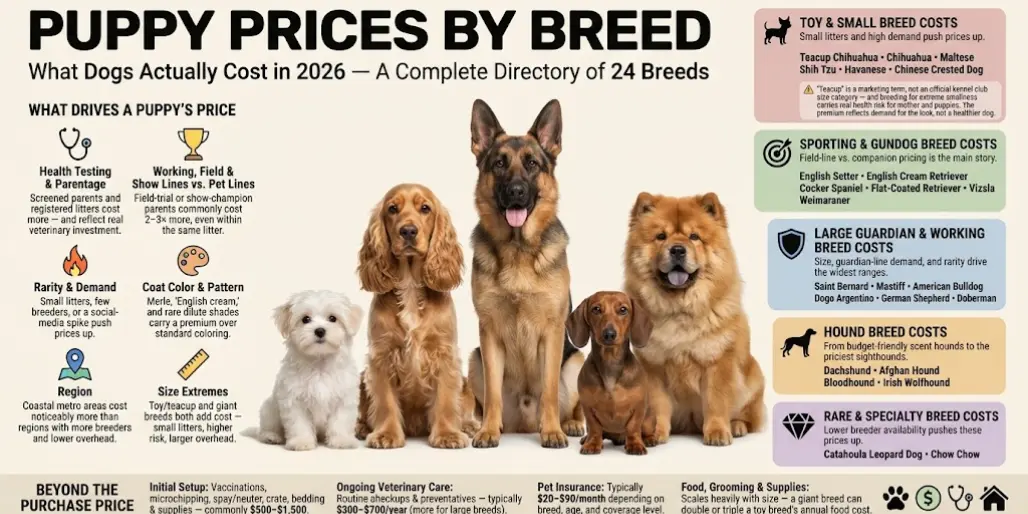
The sticker price on a puppy listing is rarely the full story. What a dog actually costs depends on size, rarity, coat color, working vs. show lines, health testing, your region, and, for a handful of breeds, demand driven by trends rather than anything to do with the dog itself. This directory breaks down real-world pricing for 24 breeds, grouped by what actually drives their cost, so you can budget with an honest number instead of the first price you see in an Instagram ad.
What actually drives a puppy’s price
A few factors repeat across almost every breed in this guide, and understanding them explains most of the price spread you’ll see between two puppies of the same breed:
- Health testing and parentage. Breeders who screen parent dogs for hip dysplasia, eye conditions, or breed-specific genetic issues, and who register litters with a kennel club, charge more, and that cost reflects real, ongoing veterinary investment rather than markup for its own sake.
- Working, field, and show lines vs. pet lines. A puppy from field-trial or show-champion parents commonly costs two to three times more than a pet-quality puppy from the same breeder, even within the same litter.
- Rarity and demand. Breeds with small litters, limited numbers of active breeders, or a sudden spike in popularity (often from social media or a celebrity owner) see prices climb regardless of the breed’s actual rarity in nature.
- Coat color and pattern. Unusual colors, merle, “English cream,” or rare dilute shades, routinely carry a premium over standard coloring, sometimes a significant one. This is worth understanding before you pay it; see why merle coloring costs more, and what to ask a breeder before you pay the premium.
- Region. The same breed can cost noticeably more in high-demand coastal metro areas than in regions with more breeders and lower overhead.
- Size extremes. Both ends of the size spectrum add cost, toy and “teacup” dogs because of small litters and higher breeding risk, giant breeds because of the higher cost of raising and health-testing a large-bodied litter.
A word on “teacup” and extreme-small pricing
Several of the breeds in this guide, most notably the Teacup Chihuahua, carry a price premium tied to size that’s worth understanding before you pay it. “Teacup” isn’t an official size category recognized by major kennel clubs, it’s a marketing term for the smallest end of an already-small breed, and breeding deliberately for extreme smallness carries real added health risk for both the mother and the puppies. The premium price reflects demand for the look, not a more robust or higher-quality dog, if anything, often the opposite. Our Toy & Small Breed Costs guide covers this in more detail.
Browse by group
🐕 Toy & Small Breed Costs
The toy end of the spectrum, where small litters and high demand both push prices up. → Toy & Small Breed Costs, Teacup Chihuahua, Chihuahua, Maltese, Shih Tzu, Havanese, Chinese Crested Dog
🎯 Sporting & Gundog Breed Costs
Field-line pricing versus companion pricing is the main story in this group. → Sporting & Gundog Breed Costs, English Setter, English Cream Retriever, Cocker Spaniel, Flat-Coated Retriever, Vizsla, Weimaraner
🛡️ Large Guardian & Working Breed Costs
Size, guardian-line demand, and rarity drive some of the widest price ranges in this directory. → Large Guardian & Working Breed Costs, Saint Bernard, Mastiff, American Bulldog, Dogo Argentino, German Shepherd, Doberman
🐾 Hound Breed Costs
From budget-friendly scent hounds to some of the priciest sighthounds around. → Hound Breed Costs, Dachshund, Afghan Hound, Bloodhound, Irish Wolfhound
💎 Rare & Specialty Breed Costs
Lower breeder availability is the common thread pushing these prices up. → Rare & Specialty Breed Costs, Catahoula Leopard Dog, Chow Chow
Beyond the purchase price
The number on a breeder’s listing is the beginning of the budget, not the end of it. Across every breed in this guide, plan for:
- Initial setup: vaccinations, microchipping, spay/neuter, a crate, bedding, and basic supplies, commonly $500–$1,500 depending on size
- Ongoing veterinary care: routine checkups and preventatives typically run $300–$700 a year for most breeds, more for larger dogs or breeds prone to genetic conditions
- Pet insurance: increasingly common, typically $20–$90 a month depending on breed, age, and coverage level
- Food, grooming, and supplies: scales heavily with size, a giant breed can easily double or triple a toy breed’s annual food cost
Price ranges in this guide reflect typical reputable-breeder pricing in the US as of 2026 and will vary by region, individual breeder, and lineage, treat them as a planning baseline, not a quote.
This article is for general information only. Always research a breeder’s health testing and reputation directly before purchasing a puppy.