
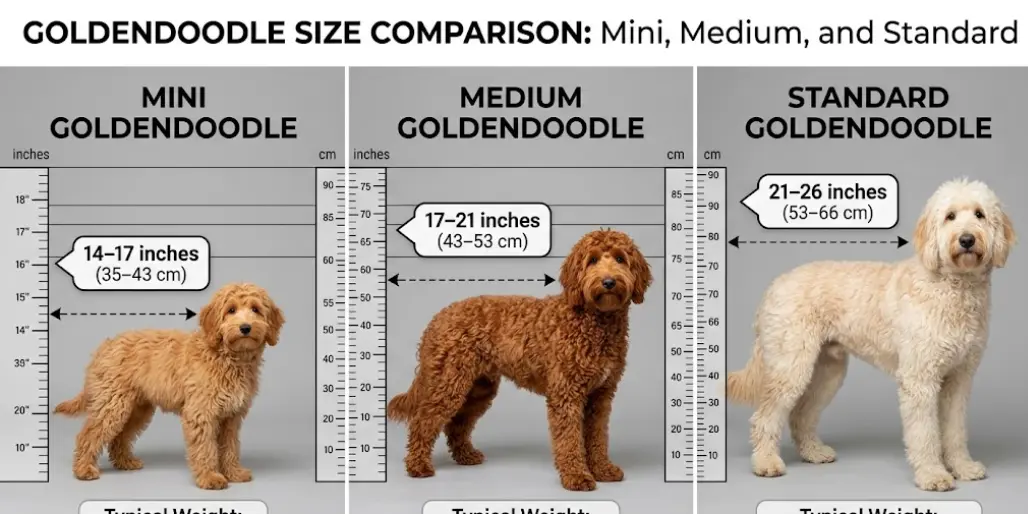
If you are wondering what goldendoodle size your future pet will reach, you need to look at the specific parent breeds involved, such as standard poodles, miniature poodles, and golden retrievers. Every goldendoodle puppy grows at a different rate depending on whether it belongs to a mini, medium, or standard size category.
Understanding Goldendoodle Sizes
Figuring out the adult size of your doodle requires looking closely at the weight range of the sire and dam. When you bring home a cute pup, understanding how each puppy can vary within the same litter helps you prepare for their growth. A reputable breeder can often provide a reliable growth chart to estimate your dog breed expectations.
What is a Goldendoodle
A goldendoodle is a popular crossbreed resulting from a mix between poodles and golden retrievers, known for being wonderful family dogs with an amazing temperament. Whether you adopt a small goldendoodle or a large goldendoodle, this canine companion will bring immense joy. Many doodle owners consult a veterinarian or look at a puppy’s size around the six-month-old mark to track development.
Different Goldendoodle Sizes Explained
You can find everything from a tiny toy poodle mix to a massive F1B goldendoodle weighing over 75 lbs. Every full-grown pup has unique traits, whether it is an F1 generation or a multi-generational puppy.
| Goldendoodle Type | Weight / Size Details |
| Mini / Miniature Goldendoodle | Typically stays under 25 lbs |
| Standard Goldendoodle | Can easily exceed 25 lbs once it reaches a year and a half |
Factors Influencing Goldendoodle Size
Genetics play the biggest role in determining if your full-grown goldendoodles will be petite or extra large. The specific variety of miniature poodle or standard poodle used in the breeding process dictates the final weight. Checking a detailed growth chart or talking with your veterinarian ensures you know what to expect as your furry friend matures into adulthood.
Goldendoodle Growth Chart
Following a reliable growth chart helps you track your goldendoodle puppy as it transitions from a tiny pup into a healthy adult size. Every mini goldendoodle and standard golden doodle reaches milestones differently, so watching your dog breed closely over the first year and a half makes a huge difference in managing their overall care.
Puppy Growth Stages
During the early months, every puppy in a litter develops at a surprisingly fast pace, especially when crossbreeding poodles and golden retrievers. Your veterinarian can check the puppy’s size at the six-month-old mark to give you an accurate prediction of their final weight range and overall canine development.
Adult Size Expectations
Reaching the final adult size usually happens around a year and a half. Checking the specific parent breeds helps you understand if your doodle will remain petite or grow quite large.
| Goldendoodle Size Type | Weight Range |
| Small | Under 25 lbs |
| Large | Exceeding 75 lbs |
Mini Goldendoodle Size Insights
A mini goldendoodle or miniature variety is fantastic for owners wanting a more compact companion instead of a massive standard poodle mix. Whether you have an F1 or an F1B goldendoodle, understanding the exact goldendoodle size expectations keeps you well-prepared for your pet.
Goldendoodle Coat Types
Every goldendoodle inherits a distinct coat from the poodles and golden retrievers in their lineage, requiring specific grooming routines. While exploring our comprehensive Goldendoodle Guide, you will discover how different hair textures affect your daily maintenance and overall brushing schedule for your furry friend.
Common Coat Types in Goldendoodles
Doodle owners frequently encounter wavy, curly, or straight coats on their goldendoodles, depending on whether the puppy inherited more traits from the golden retriever or the poodle. Each coat type changes how your dog looks, ranging from a shaggy look to a tight, hypoallergenic curl pattern.
Impact of Coat Type on Size
While coat texture does not directly change the physical goldendoodle size, a thick, curly coat can make your full-grown goldendoodle look much larger and fluffier than it actually is. Grooming styles also play a huge role in altering the visual appearance of your pet.
Choosing the Right Coat for Your Doodle
Selecting the best coat type comes down to personal preference and how much time you want to spend brushing your canine companion. To learn more about finding the perfect puppy for your lifestyle, be sure to check out the resources provided by PawandBreeds.
F1B Goldendoodles and Their Sizes
When you start researching an F1B goldendoodle, you quickly realize this specific crossbreed involves breeding a goldendoodle back to a purebred poodle. This backcrossing process usually creates a very predictable, low-shedding coat and helps lock in that wonderful family dog temperament everyone loves so much.
What is an F1B Goldendoodle?
An F1B goldendoodle is created by pairing an F1 goldendoodle with either a miniature poodle or standard poodle. This means your puppy inherits roughly seventy-five percent poodle genetics, which heavily influences both their curly hair texture and their overall final adult size range.
Size Variations in F1B Goldendoodles
Depending on whether the parent breeds featured a toy poodle or a larger standard poodle, your F1B goldendoodle can range from a tiny twenty-five lb lap dog to a much bigger companion. Every individual pup in a litter might grow at a different speed.
Considerations for Doodle Owners
Doodle owners need to remember that even an F1B goldendoodle requires regular veterinary checkups and consistent grooming to manage that heavy poodle influence. Keeping an eye on your growing canine friend ensures they stay healthy as they reach their full adult weight.
Conclusion
Recap of Goldendoodle Sizes
Understanding the goldendoodle size variations means looking closely at your puppy’s lineage. Every dog breed grows differently based on genetics, parent breeds, and proper nutrition during their first year and a half.
The different size variations include:
| Size Variation | Description |
| Mini goldendoodle | Smaller lineage variation |
| Medium crossbreed | Mid-sized lineage variation |
| Standard goldendoodle | Massive lineage variation |
Final Tips for Doodle Owners
Always consult your trusted veterinarian and rely on an accurate growth chart to track your favorite pup from a small dog stage into a healthy adult. Proper care, routine grooming, and plenty of love will help your furry family member thrive throughout their entire life.
Explore More in the Goldendoodle Guide
To dive deeper into everything related to this amazing crossbreed, you can easily read through the helpful Goldendoodle Guide. For more expert tips on finding your next pet, be sure to visit PawandBreeds for all the latest advice.
FAQ
Q: How can I tell what size my goldendoodle puppies will grow up to be?
A: Figuring out the future size of goldendoodle puppies can be tricky, but looking at the size of the poodle parent and the other side of the family gives you a solid clue. You can also use a weight predictor or calculator to get a pretty good estimate based on their current growth.
Q: Are mini goldendoodles much smaller than standard ones?
A: Oh yeah, mini goldendoodles are way smaller! While standard pups grow up to be quite tall and heavy, minis stay pocket-sized because they are bred with smaller poodles.
Q: When do most goldendoodles reach their full grown size?
A: Most pups hit their full grown size anywhere between 10 to 15 months of age, though some of the really large goldendoodles might keep filling out until they are about 18 months old.
Q: What is a good way to estimate my goldendoodle puppy’s adult weight?
A: A common trick for a goldendoodle puppy’s weight prediction is to take their weight at a certain month old—usually around 4 months—and double it, though this is just a rough estimate and not an exact science.
Q: How heavy will large goldendoodles get when they are fully matured?
A: Big ones, often compared in heft to a labrador retriever or even a standard labradoodle, usually tip the scales anywhere from 50 to 90 pounds or even more depending on their breeding standards.
Q: Do healthy dogs like these stop growing suddenly at 11 months?
A: Not really, because even though healthy dogs slow down their height growth around 11 months, they still pack on some muscle and chest width as they mature into adults.
Q: How does a puppy’s bone structure help predict its final size?
A: If you check out their paws and rib cage, you can usually tell if they are going to be a giant fluff ball or a smaller companion; a wider rib cage and chunky legs usually mean a stockier, heavier adult dog.
Q: Are golden doodle sizes influenced more by the retriever side or the poodle side?
A: It really depends on the specific generation and the size of the poodles and goldens in the family tree, since mixing a tiny toy poodle with a big retriever creates a total wildcard in terms of final height and weight.
Q: Is there any exact math formula or calculation I can trust for sizing?
A: Any growth calculation you find online is just for fun and guidance because genetics can throw curveballs, meaning your pup might end up bigger or smaller than the math predicts.





