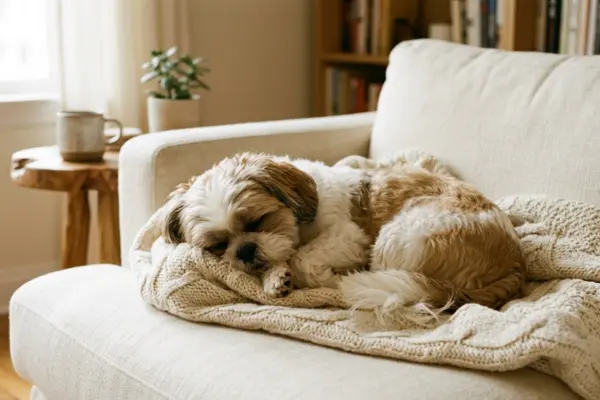
Small dogs fit more homes than big ones, but “small” covers a huge range, from a 4-pound toy breed to a 25-pound terrier with a big personality. This guide pulls the most common small-dog questions into one place: which small breeds suit kids and apartments, which bark and shed less, which are the smartest, how three popular comparisons shake out, and how to pick a name. Every list reflects tendencies, not guarantees. Individual training, socialization, and grooming decide how any one dog turns out.
What actually decides whether a small dog is right for you
- Energy, not size. Some of the most demanding breeds are small. A Jack Russell Terrier needs far more exercise and mental work than many large breeds.
- Fragility. Toy breeds can be injured by falls, rough play, and being stepped on, which matters most around young children.
- Noise. Small dogs often bark more, partly because many were bred as alert watchdogs.
- Coat care. A low-shedding coat still needs regular brushing and grooming, and often costs more to maintain than a short coat.
- Health. Small breeds tend to live longer than large ones, but each has its own risks, such as dental disease, kneecap problems, and in some breeds, heart disease.
Best small dogs for kids
A good small dog for children is sturdy enough for play, patient, and tolerant of handling. These breeds are commonly recommended:
- Cavalier King Charles Spaniel: Outgoing, gentle, and playful, and built sturdily enough for family life.
- Bichon Frise: Cheerful and people-oriented.
- Havanese: Affectionate, social, and adaptable.
- Miniature Poodle: Smart and trainable, and usually patient with children.
- Boston Terrier: Friendly and lively with moderate exercise needs.
- Shih Tzu: Gentle and affectionate, though it may tolerate rough handling less well.
Very small toy breeds such as Chihuahuas and Yorkshire Terriers are often listed as poor matches for young children, mainly because they are fragile and can bite if handled roughly or frightened. Whatever the breed, supervise young children around any dog, teach them how to handle one gently, and give the dog a quiet place to retreat to.
Best small dogs for apartments
The best apartment dogs are quiet, calm indoors, and happy with a moderate amount of exercise. Common choices include the Cavalier King Charles Spaniel, French Bulldog, Shih Tzu, Havanese, Bichon Frise, Boston Terrier, and Maltese.
Three things matter more than size:
- Noise. Walls are thin, so a breed that barks at every sound can cause problems with neighbors. See the section on small dogs that don’t bark below.
- Energy. A high-drive terrier shut in a small space often becomes destructive and loud. Match the dog’s energy to the time you have for walks and play.
- Potty access. Apartment life usually means stairs, elevators, and scheduled walks. Small dogs have small bladders, so plan for frequent trips, especially for puppies.
Small dogs that don’t bark
No dog is completely silent, and barking is a mix of breed tendency, boredom, anxiety, and training. Some small breeds are known for being quieter, though:
- Basenji: Famous for not barking in the usual way. It makes a yodel-like sound and other noises instead, so it isn’t silent. It is also independent and energetic, which makes it a challenging first dog.
- Cavalier King Charles Spaniel: Generally friendly with everyone, so less inclined to bark at visitors.
- French Bulldog: Typically barks less than many small breeds, though individuals vary.
- Shih Tzu and Havanese: Often described as moderate barkers rather than constant alert dogs.
Breeds that tend to bark more include many terriers and toy breeds that were bred to sound an alarm. To keep barking down in any breed, give enough exercise and attention, teach a “quiet” cue early, and reward calm behavior.
Small dogs that don’t shed
No dog sheds nothing, but some small breeds shed very little, and their loose hair tends to stay in the coat instead of landing on your furniture:
- Maltese
- Yorkshire Terrier
- Shih Tzu
- Havanese
- Bichon Frise
- Miniature Schnauzer
- Miniature Poodle
Low shedding comes with a cost. These coats mat if they aren’t brushed regularly and usually need professional grooming every several weeks, so you trade vacuuming for brushing and grooming bills. Low shedding is also different from being allergy-friendly. Allergens come from dander and saliva as well as hair, so a low-shedding dog may still trigger symptoms. If anyone in your home has allergies, spend time with the specific dog first.
Smartest small dog breeds
The most widely cited ranking is Stanley Coren’s, based on surveys of dog obedience judges in his book The Intelligence of Dogs. It measures how quickly dogs learn and obey commands, which is working and obedience intelligence, not intelligence in every sense. Small breeds that rank high include:
- Miniature and Toy Poodle: The Poodle placed second overall in Coren’s ranking, and comes in every size.
- Papillon: The first toy breed on the list, ranked in the top ten and a top agility performer.
- Shetland Sheepdog: Small to medium and one of the top-ranked herding breeds.
- Pembroke Welsh Corgi: Small to medium and ranked in the top dozen.
- Miniature Schnauzer: Quick to learn and alert.
Size doesn’t determine intelligence. A breed ranking low on obedience, such as the Shih Tzu or Beagle, isn’t necessarily “less smart,” it may simply be more independent. Smart dogs also need more mental stimulation, and a bored clever dog can invent its own trouble.
Tiny dogs that stay small
If you want a dog that stays tiny, choose a purebred toy breed with a known adult weight, not a mix whose puppies could grow in unpredictable ways. Typical adult weights, per breed standards, are about:
- Chihuahua: up to 6 pounds
- Yorkshire Terrier: up to 7 pounds
- Maltese: under 7 pounds
- Pomeranian: about 3 to 7 pounds
- Toy Poodle: about 4 to 6 pounds
- Papillon: about 5 to 10 pounds
- Miniature Pinscher: about 8 to 10 pounds
Avoid listings for “teacup” dogs. Teacup isn’t a recognized size category. It is a marketing term for the smallest end of an already small breed, and breeding for extreme smallness carries added risks, including fragile bones, low blood sugar, and heart and breathing problems. Ask for the adult weights of both parents, and be wary of any breeder who promises a size they can’t back up.
Cavalier King Charles Spaniel vs. Maltese
| Cavalier King Charles Spaniel | Maltese | |
|---|---|---|
| Size | About 12 to 13 inches and 13 to 18 pounds | Under 7 pounds |
| Coat | Silky, moderate shedding, regular brushing | Single white coat, very low shedding, daily brushing |
| Temperament | Outgoing, friendly with nearly everyone | Playful and affectionate, often more watchful with strangers |
| Barking | Usually quieter | Can be a more frequent barker |
| Around kids | Sturdier, generally a better fit | Very small, so more fragile |
| Lifespan | Roughly 9 to 15 years depending on the source | Commonly 12 to 15 years |
Health. This is the biggest difference. Mitral valve disease is the most common serious condition in Cavaliers, and sources report that nearly all of them eventually develop it. The breed is also prone to syringomyelia, a painful neurological condition, as well as eye problems and patellar luxation. Maltese are not free of problems, with dental disease and kneecap issues among the common ones, but they don’t carry the same heart disease risk. If long-term health is your priority, ask any Cavalier breeder for heart screening records for both parents.
Which to choose. Pick the Cavalier for a sturdier, friendlier dog with a calmer temperament, and the Maltese for a lighter, lower-shedding dog if you can commit to daily coat care.
Male vs. female Cavalier King Charles Spaniel
The differences between the sexes are small, and the individual dog matters far more than whether it is male or female.
- Size: Males stand about 13 inches and females about 12, and both usually weigh 13 to 18 pounds, although females can run lighter. Many people can’t tell them apart by looks.
- Health: Both sexes share the breed’s main risks, including mitral valve disease, syringomyelia, and patellar luxation. Some sources report males are more prone to mitral valve disease, and females more prone to obesity and dry eye.
- Temperament: Most claims about male and female personalities are anecdotal. Some owners report unneutered males can be more territorial, but training, socialization, and neutering status affect behavior more than sex.
- What to do: Choose based on the individual puppy’s temperament and the breeder’s health testing, not on sex. Ask your vet when to spay or neuter.
Cavalier King Charles Spaniel vs. Cavapoo
A Cavapoo is a cross between a Cavalier King Charles Spaniel and a Poodle, so it can resemble either parent, and puppies in the same litter can differ.
| Cavalier King Charles Spaniel | Cavapoo | |
|---|---|---|
| Size | About 12 to 13 inches and 13 to 18 pounds | Depends on the Poodle parent, usually smaller or similar |
| Coat | Silky, moderate shedding | Wavy or curly, often lower shedding but not guaranteed |
| Grooming | Regular brushing | Needs more, since curly coats mat easily |
| Predictability | A breed with a defined standard | A cross, so size, coat, and temperament vary |
| Health | High risk of mitral valve disease and syringomyelia | May reduce, but does not remove, those risks |
Health. Mixing in a Poodle may lower the odds of some Cavalier conditions, but it doesn’t eliminate them, and a Cavapoo can still inherit mitral valve disease. Ask for health screening on both parents. Coat. Cavapoos are often chosen for low shedding, but a Cavapoo can inherit the Cavalier’s shedding coat, and neither dog is hypoallergenic. Which to choose. A Cavalier is more predictable, while a Cavapoo offers a chance at a lower-shedding coat in exchange for more grooming and more variation.
Small dog names
Small dogs often suit short, bright names that are easy to call. A few tips before choosing:
- Pick one or two syllables, which are easiest for dogs to learn.
- Avoid names that sound like commands, such as “Kit” (sit) or “Beau” (no).
- Say it out loud in the voice you’d use at the park, because you’ll be using it often.
- Give it a few days before settling, since a name often fits only after you’ve lived with the dog.
Classic: Daisy, Lucy, Penny, Molly, Ruby, Coco, Bella, Millie
Food and treats: Biscuit, Pickle, Mochi, Waffles, Peanut, Nugget, Churro, Olive
Nature: Willow, Poppy, Clover, Pebble, River, Juniper, Maple, Sage
Big names for tiny dogs: Tank, Moose, Bruiser, Titan, Hercules, Duke, Rex
Gender-neutral: Remy, Finn, Ziggy, Bailey, Rowan, Sunny, Toby, Charlie
Best small boy dog names
Classic: Max, Charlie, Milo, Teddy, Oscar, Buddy, Jack, Leo
Strong and playful: Bruno, Rocky, Ziggy, Gus, Otis, Louie, Murphy, Rufus
Food and quirky: Biscuit, Waffles, Peanut, Meatball, Nacho, Pretzel, Cosmo, Pickles
Big names for small boys: Tank, Moose, Duke, Bear, Thor, Zeus, Rambo, Brutus
Short and sweet: Benny, Archie, Finn, Fred, Hank, Jax, Roo, Sam
Breeds that show up on several lists
- Cavalier King Charles Spaniel: a good fit for kids, apartments, and quieter homes, but heart screening is essential.
- Bichon Frise: good with kids, suits apartments, and sheds little, but needs regular grooming.
- Havanese: social, adaptable, and low-shedding.
- Miniature Poodle: smart, low-shedding, and usually patient with children, with a coat that needs regular grooming.
- Shih Tzu: suits apartments and sheds little, but is slower to train than Poodles.
This article is for general information only and isn’t a substitute for advice from your veterinarian or a certified trainer. Individual dogs vary widely within any breed.