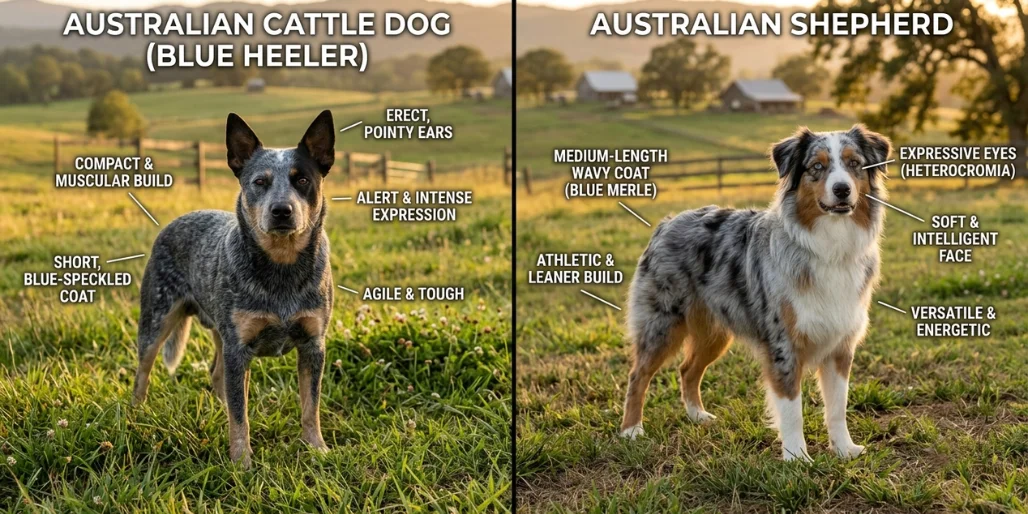
Thinking about getting an Australian Cattle Dog or an Australian Shepherd? These two breeds, often confused due to their similar names and herding backgrounds, actually have some pretty distinct differences. While both are intelligent and energetic herding dog breeds, understanding their unique traits can help you choose the perfect companion for your lifestyle. We’ll explore the key differences between these remarkable working dog breeds so you can make an informed decision and perhaps even discover a new favorite from Pawandbreeds.
What Are the Key Differences Between Australian Cattle Dogs and Australian Shepherds?
The main differences between an Australian Cattle Dog and an Australian Shepherd lie in their physical attributes, temperament, and activity requirements. Both breeds are highly intelligent and possess strong herding instincts. However, their original purpose has led to distinct traits, as shown below:
| Breed | Original Herding Purpose |
| Australian Cattle Dog (Blue Heeler/Queensland Heeler) | Herding cattle over long distances in rugged terrain |
| Australian Shepherd | Herding sheep |
This fundamental difference in their original purpose has made them suited for different types of families and lifestyles.
Physical Characteristics
When you look at an Australian Cattle Dog vs. Australian Shepherd, you’ll immediately notice differences in their appearance. These two breeds definitely have their own unique looks.
| Feature | Australian Cattle Dog | Australian Shepherd |
| Common Names | Blue Heeler, Red Heeler | Aussie |
| Build | Sturdy, muscular, powerful, agile | |
| Coat Length & Texture | Short, dense double coat | Medium-length, wavy or straight double coat |
| Coat Colors & Patterns | Blue or red merle patterns, often with speckling or mottling | Blue merle, red merle, black, and red, often with white and tan markings |
| Ears | Erect | |
| Eyes | Striking blue, amber, or marbled | |
| Tail | Naturally bobbed or full |
Temperament and Behavior
Both the Australian Cattle Dog and the Australian Shepherd are intelligent working breeds, excelling in various dog sports. However, they exhibit distinct temperamental differences.
| Trait | Australian Cattle Dog | Australian Shepherd |
| Temperament | Alert, intelligent, highly loyal to owner, reserved around strangers, unwavering work ethic. | Generally more outgoing and eager to please, strong desire for human companionship, openly affectionate. |
| Herding Style | “Heel” cattle, nipping at heels (can translate to herding children/pets). | Excellent working dog, pronounced eagerness to participate in family activities. |
Exercise and Activity Needs
Both the Australian Cattle Dog and Australian Shepherd are high-energy dog breeds that require substantial exercise and mental stimulation, but there are subtle differences in the intensity and type of activity they thrive on. Australian Cattle Dogs, bred to herd cattle over long distances, possess incredible stamina and endurance, needing vigorous daily exercise that goes beyond a simple walk. They excel in activities like agility, flyball, and advanced obedience, which provide an outlet for their strong working dog instincts. The Australian Shepherd, while also high energy, often enjoys a wider variety of activities that involve their family, such as hiking, fetch, or dog sports like frisbee, as they thrive on interaction and having a “job” to do alongside their human companions. Both breeds will become bored and potentially destructive without adequate physical and mental engagement.
How Does the Grooming Requirement Differ Between an Australian Cattle Dog and an Australian Shepherd?
The grooming requirements for an Australian Cattle Dog and an Australian Shepherd differ significantly due to their distinct coat types. While both are working dog breeds that need some level of care, the Australian Shepherd, with its longer, denser coat, generally demands more frequent and specialized grooming compared to the Australian Cattle Dog, often referred to as a Blue Heeler or Red Heeler. Understanding these differences is crucial for any potential owner to ensure their canine companion stays healthy and comfortable. Pawandbreeds offers a range of grooming products to help with both breeds.
Coat Types and Shedding
The Australian Cattle Dog sports a short, dense double coat that is relatively low maintenance, making it easier to groom. This coat is designed to protect them from harsh weather while herding cattle over long distances. They do shed, particularly seasonally, but their short hair means less matting and tangling. In contrast, the Australian Shepherd boasts a medium-length double coat that can be straight or wavy, and it comes in various colors, often with striking blue merle or red merle patterns. This longer coat, while beautiful, is prone to shedding year-round and requires more attention to prevent mats and tangles, especially in areas like their “feathers” on legs and tail.
Grooming Frequency
Due to their differing coat types, the frequency of grooming also varies between these two breeds. An Australian Cattle Dog typically requires brushing once or twice a week to remove loose hair and keep their coat healthy. During shedding seasons, this might increase to two or three times a week. The Australian Shepherd, however, demands more frequent grooming, ideally two to three times a week, and even daily during heavy shedding periods. Regular brushing helps to distribute natural oils, prevent matting, and keep their coat in good condition. Both breeds benefit from occasional baths, but over-bathing can strip natural oils.
Special Grooming Techniques
When it comes to special grooming techniques, the Australian Shepherd generally requires more specific attention than the Australian Cattle Dog. For an Aussie, regular dematting around the ears, armpits, and behind the legs is essential to prevent painful mats. Using a slicker brush and an undercoat rake is often recommended to effectively manage their dense double coat. For the Australian Cattle Dog, a rubber curry brush or a shedding blade is usually sufficient to manage their shorter coat and minimize shedding. Neither breed typically requires professional trimming, but attention to nail trims, ear cleaning, and dental hygiene is crucial for both to maintain overall health.
What Should You Know About the Training of Australian Cattle Dogs vs. Australian Shepherds?
Understanding the training needs of an Australian Cattle Dog vs. Australian Shepherd is crucial for any potential owner, as both are highly intelligent, high-energy working dog breeds, but their approaches to learning can differ significantly. The key to successful training for either breed lies in early socialization, consistency, and positive reinforcement, taking into account their unique temperaments and innate herding dog instincts. These dogs thrive on having a “job” to do, and channeling their intelligence into structured training is essential to prevent boredom and unwanted behaviors. Pawandbreeds emphasizes responsible training practices for all dogs.
Trainability and Intelligence
Both the Australian Cattle Dog and the Australian Shepherd are renowned for their exceptional intelligence and trainability, making them highly capable of learning complex commands and tasks. The Australian Cattle Dog, often called a Blue Heeler or Queensland Heeler, exhibits a strong desire to please its owner and can quickly pick up new skills, particularly those related to herding or problem-solving. Similarly, the Australian Shepherd, or Aussie, is known for its eagerness to learn and excel in various dog sports, showcasing remarkable mental agility. Both breeds thrive on mental stimulation and respond well to consistent, positive reinforcement training methods, allowing them to become well-behaved and adaptable companions.
Common Training Challenges
Despite their intelligence, both the Australian Cattle Dog and Australian Shepherd present unique training challenges. Australian Cattle Dogs, bred to herd cattle over long distances, can sometimes exhibit a strong independent streak and a tendency to “heel” or nip at people’s ankles, a behavior that needs to be redirected early on. Their high energy levels and demand for mental stimulation mean that boredom can quickly lead to destructive behaviors if not properly managed. Australian Shepherds, while generally more eager to please, can sometimes be prone to excessive barking or herding behaviors towards children or other pets if not adequately trained and socialized. Both breeds can be wary of strangers, requiring careful socialization from a young age to prevent reactivity.
Best Training Practices
For both Australian Cattle Dogs and Australian Shepherds, the best training practices involve early socialization, consistent positive reinforcement, and a focus on channeling their natural herding dog instincts into productive activities. Starting obedience training from puppyhood is essential, establishing clear boundaries and commands. Engaging them in mentally stimulating dog sports like agility, obedience, or flyball can provide an excellent outlet for their high energy levels and intelligence. Short, frequent training sessions with plenty of praise and treats work best for these smart breeds. Regular exercise combined with mental challenges will ensure a well-adjusted and happy companion, preventing common issues like destructive chewing or excessive barking.
Are There Specific Health Concerns for Each Breed?
Yes, both Australian Cattle Dogs and Australian Shepherds, like many purebred working dog breeds, have specific health concerns that potential owners should be aware of. While both are generally robust and healthy dogs, understanding the genetic predispositions of each breed can help you provide the best preventive care and recognize early signs of potential issues. This knowledge is crucial for ensuring a long and healthy life for your high-energy companion, whether it’s a Blue Heeler or an Aussie.
Common Health Issues in Australian Cattle Dogs
Australian Cattle Dogs, often called Blue Heelers or Queensland Heelers, are known for their hardy nature, but they can be prone to certain genetic health problems. One of the most common concerns for this breed is hip dysplasia and elbow dysplasia, which are abnormal formations of the hip and elbow joints. Progressive retinal atrophy (PRA), a degenerative eye disease leading to blindness, is also seen in the breed. Additionally, some Australian Cattle Dogs can be affected by hereditary deafness, a condition that can impact one or both ears. Responsible breeders will screen their breeding stock for these issues to minimize their occurrence.
Health Problems in Australian Shepherds
Australian Shepherds also have their own set of potential health challenges. Similar to Cattle Dogs, hip dysplasia and elbow dysplasia are concerns for Aussies. A significant genetic issue in Australian Shepherds is the MDR1 gene mutation, which can cause sensitivity to certain medications. Eye problems are particularly prevalent, including cataracts, collie eye anomaly (CEA), and progressive retinal atrophy (PRA). Epilepsy can also affect this breed, manifesting as seizures. Responsible breeders use genetic testing to identify and avoid passing on these conditions, helping to ensure healthier Australian Shepherd puppies.
Preventive Care and Health Management
For both Australian Cattle Dogs and Australian Shepherds, preventive care and proactive health management are key to a long and happy life. Regular veterinary check-ups, a balanced diet, and consistent exercise are fundamental. For these high-energy breeds, maintaining a healthy weight is crucial to prevent strain on their joints. Genetic testing for conditions like hip and elbow dysplasia, PRA, and the MDR1 mutation (for Aussies) is highly recommended for breeders and potential owners. Early socialization and training also contribute to their overall well-being, helping them become well-adjusted members of the family.
Which Breed Is Better for Your Lifestyle?
Deciding which breed is better for your lifestyle, an Australian Cattle Dog or an Australian Shepherd, boils down to understanding their distinct temperaments, exercise needs, and how they fit into your daily routine. Both are highly intelligent, high-energy herding dog breeds that thrive on having a job to do and plenty of mental stimulation. However, subtle differences in their family compatibility and living space requirements can make one a more suitable companion than the other for specific households.
Family Compatibility
When considering family compatibility, there are some key differences between the Australian Cattle Dog and the Australian Shepherd. Blue Heelers, while incredibly loyal to their primary owner, can be more reserved with strangers and may exhibit strong herding behaviors, sometimes nipping at heels, which needs careful management around small children. They thrive in active households that can provide a consistent routine and a “job.” Aussies, on the other hand, are often more outgoing and generally more eager to please, making them typically more openly affectionate and adaptable to various family dynamics, though they still possess strong herding instincts that need channeling.
Living Conditions and Space Requirements
Both Australian Cattle Dogs and Australian Shepherds are high-energy dogs that require ample space and mental stimulation, making them generally unsuitable for apartment living unless their exercise needs are rigorously met. An Australian Cattle Dog, bred to herd cattle over long distances, thrives with a large, securely fenced yard where they can run and play. Australian Shepherds also need significant outdoor space and thrive on having a job to do, often enjoying a wider variety of activities alongside their family. Both breeds need more than just a small backyard; they require engagement, training, and opportunities to burn off their considerable energy.
Choosing Between a Blue Heeler and an Aussie
Ultimately, choosing between an Australian Cattle Dog (Blue Heeler) and an Australian Shepherd depends on your lifestyle, experience, and what you seek in a canine companion. If you’re an experienced dog owner looking for a fiercely loyal, independent, and tireless working dog that excels in intense activities and can be a bit more reserved, a Blue Heeler might be your perfect match. If you desire a highly intelligent, eager-to-please, and generally more outwardly affectionate dog that thrives on family interaction and a variety of dog sports, an Australian Shepherd could be the ideal addition to your home. Consider your commitment to training, exercise, and mental stimulation, as both breeds demand a lot from their owners.
FAQ’s
Q: What makes each dog breed — Australian Cattle Dog vs Australian Shepherd — unique?
A: The Australian Cattle Dog (aka blue heeler) was developed in Australia as a herding dog developed in australia to work cattle in a harsh australian climate; it’s short-coated, sturdy, and known for their intelligence and high energy dogs. The Australian Shepherd, despite the name, is a modern dog with roots tied to various herding breeds like Basque and Spanish shepherd influences; it’s often longer-coated (the australian shepherd’s coat can be red and blue or merle) and bred more for versatility and show as well as work.
Q: dog breed question — what’s the difference in size and build between them?
A: In terms of size, Australian Shepherds are usually a bit taller and more moderate in build, while the Australian Cattle Dog is more compact and muscular — terms of size matter depending on whether you need a nimble herding dog or a tough cattle worker. Both are agile but the cattle dog is stockier for bumping livestock.
Q: dog breed question — how do their coats compare and which needs more grooming?
A: The Australian Shepherd’s coat can be long and comes in blue merle collies–style patterns as well as red and blue variants and needs regular brushing. The Australian Cattle Dog has a dense, short blue coat (blue coat) that’s weather-resistant and needs less grooming but more brushing during shedding seasons.
Q: dog breed question — are both suitable for herding trials and working on farms?
A: Yes, both excel in herding trials and working on farms. The Cattle Dog was developed specifically for herding cattle in tough conditions and is especially driven for stock work. The Australian Shepherd is versatile across various herding dog breeds tasks and competitive sports, often favored for agility and obedience as well.
Q: dog breed question — which one is better for a family: high energy dogs or calmer pets?
A: Both are high energy dogs and want to please, but Australian Shepherds may be slightly more people-oriented and adaptable as family pets. Australian Cattle Dogs are super loyal, sometimes more stubborn, and can be protective — they need firm training and lots of exercise to avoid bored behavior.
Q: dog breed question — how do they rank in intelligence and trainability?
A: Both are known for their intelligence and train quickly. Border Collie still often tops the list among herding breeds for pure problem-solving, but cattle dogs and shepherds are close — the australian cattle dog was developed to think independently, while australian shepherds are eager to follow commands and excel in structured training.
Q: dog breed question — any health or lifespan differences to expect?
A: Both are generally healthy but have breed-specific concerns. Australian Shepherds can have genetic eye issues and merle-related problems if improperly bred, so check the breed standard and look for responsible breeders or purebred australian certifications. Cattle Dogs can have hip or progressive deafness in some lines; regular vet checks and asking about clearances helps.
Q: dog breed question — how do kennel clubs and breed standards treat them (like American Kennel Club)?
A: The American Kennel Club and other registries have distinct breed standards outlining size, coat, color, and temperament. The Australian Shepherd’s coat and color patterns (like blue merle) are detailed in standards; the Australian Cattle Dog’s blue coat and working ability are emphasized. For show or breeding, follow the official breed standard and health guidelines.
Q: dog breed question — what other herding breeds are they often compared to (kelpie, dingo, german shepherd)?
A: People compare them to kelpie and border collie for herding style and to german shepherd for working-drive and intelligence. The kelpie is another herding dog developed in australia known for stamina, while dingo genetics are sometimes mentioned historically. If you want a short-coated, rugged cattle dog choose the blue heeler; if you want a flashy, versatile herding partner pick the Australian Shepherd.